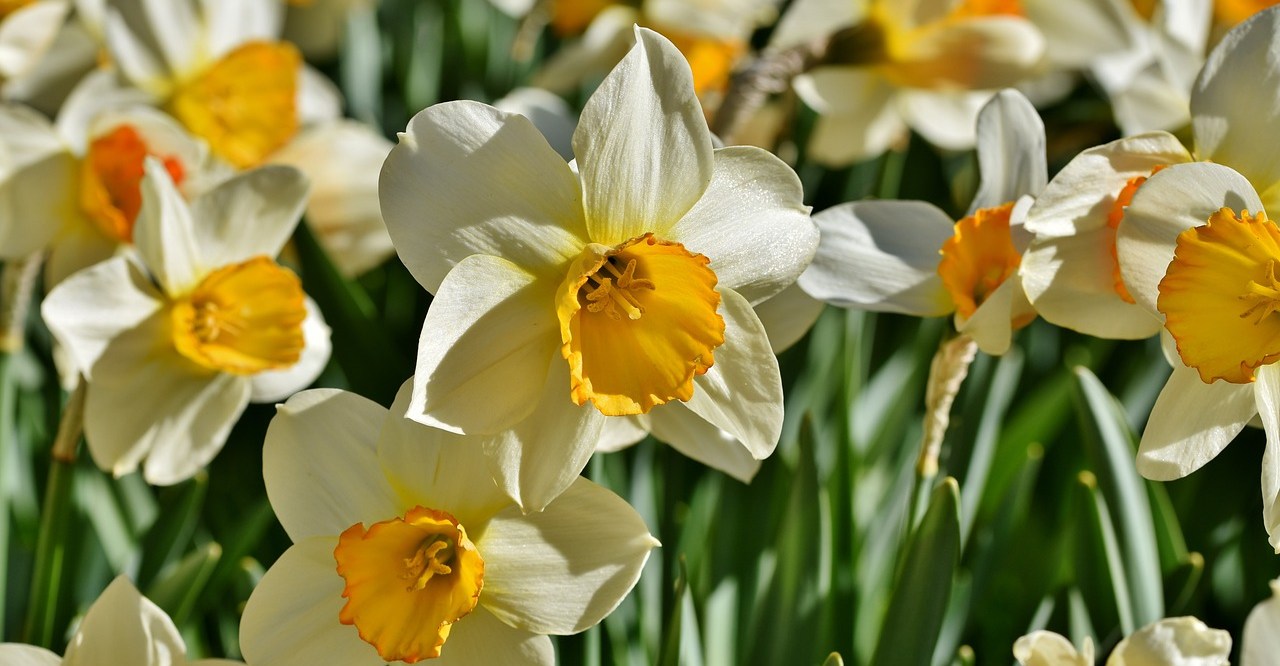

I almost missed out on daffodils this year. When we left Wakefield to visit our granddaughter their buds had barely opened. Landing in England a seven-hour flight later, the daffodils in the London parks were practically over. Just a few dried-up heads remained, burnt at the edges by the strengthening sun.
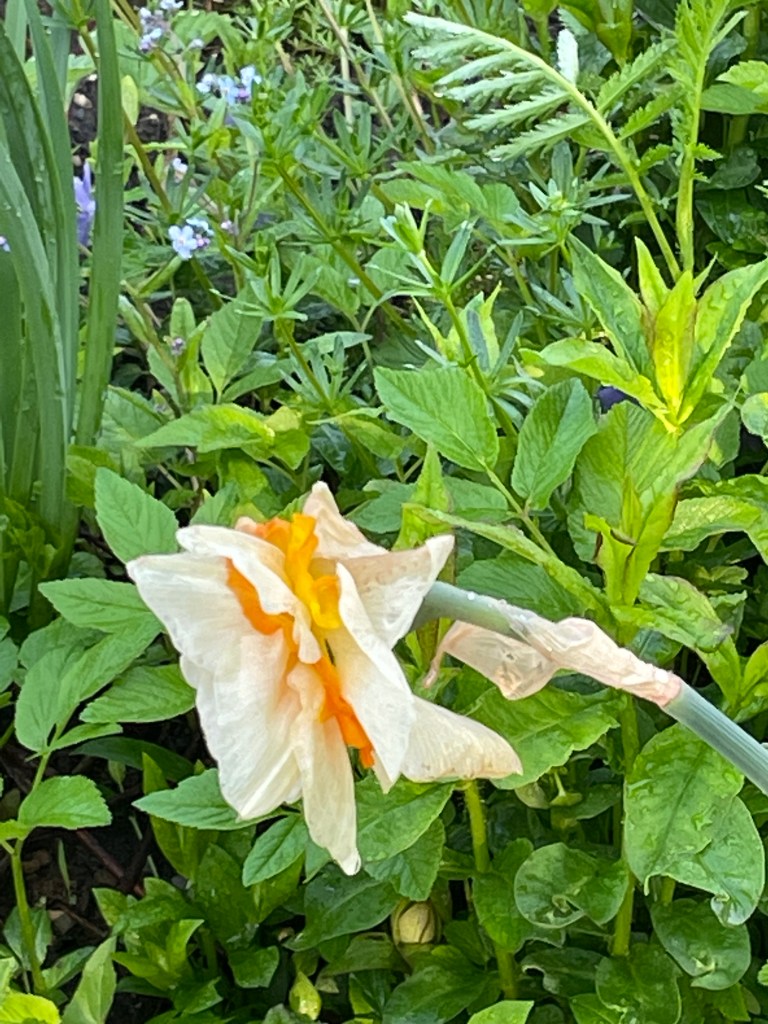
I didn’t know that I cared about daffodils until I realized that by the time I returned to Canada the daffodils in my garden would likely also have flowered and frizzled, and I would have missed out on daffodil season.
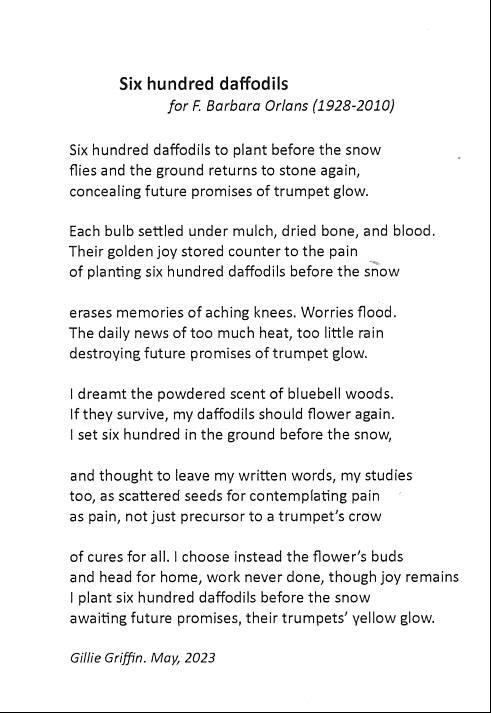
The daily news of too much heat, too little rain
Destroying future promises of trumpet glow.
Daffodils were everywhere in the springs of my childhood. My brothers were members of the local scout troop, and fortunate to live close to Kibblestone scout camp. A visit by the Chief Scout one autumn brought a mass of Cub Scouts to the site. Each cub was given a daffodil bulb, and, at the sound of a whistle raced up into the wooded banks to plant their bulb among the trees. Ever since, the camp has held an open day late March/early April so anyone can enjoy the mass plantings on Daffodil Sunday.
Daffodils are the national flower of Wales, and have been since the nineteen century, chosen as they can be relied on to bloom (in Wales anyway!) by March 1st, St David’s day. St David, the patron saint of Wales apparently died on March 1st, although as he lived during the sixth century, there is no certainty of the exact date (or year) of his death. My father was Welsh, born on St David’s day, and must, I think have absorbed St David’s teachings – to do the little things, be joyful and keep the faith — sentiments I heard expressed often growing up.
Each autumn, I would work side by side with my Mum, digging holes, adding blood and bone meal, settling each daffodil bulb in the soil, tamping it down, and watering each well. When she was recovering from surgery one year, I stayed with her, and the children and I planted daffodils around the base of the trees in front of her house, so that they would bring her joy come spring.
Each bulb settled under mulch, dried bone, and blood.
Their golden joy stored counter to the pain.
I’ve continued to plant daffodils most years, wherever I have lived. Sometimes just a few, sometimes as many as fifty at a time. It’s hard work.
...the pain
of planting six hundred daffodils before the snow
erases memories of aching knees...
It’s hard work, and sometimes, when the temperatures soar quickly, and the daffodils barely have time to push through the earth before flowering and shrivelling in the heat, I wonder if the effort is worthwhile, and whether as our climate changes daffodils will become increasingly rare in Canada.
Twenty-five or thirty years ago, I remember the same worries being expressed in the UK about bluebells. Bluebells, like daffodils, need a long cool spring to grow and flower. So, visiting the UK this April, it made my heart sing to find the bluebell woods were still in full bloom.
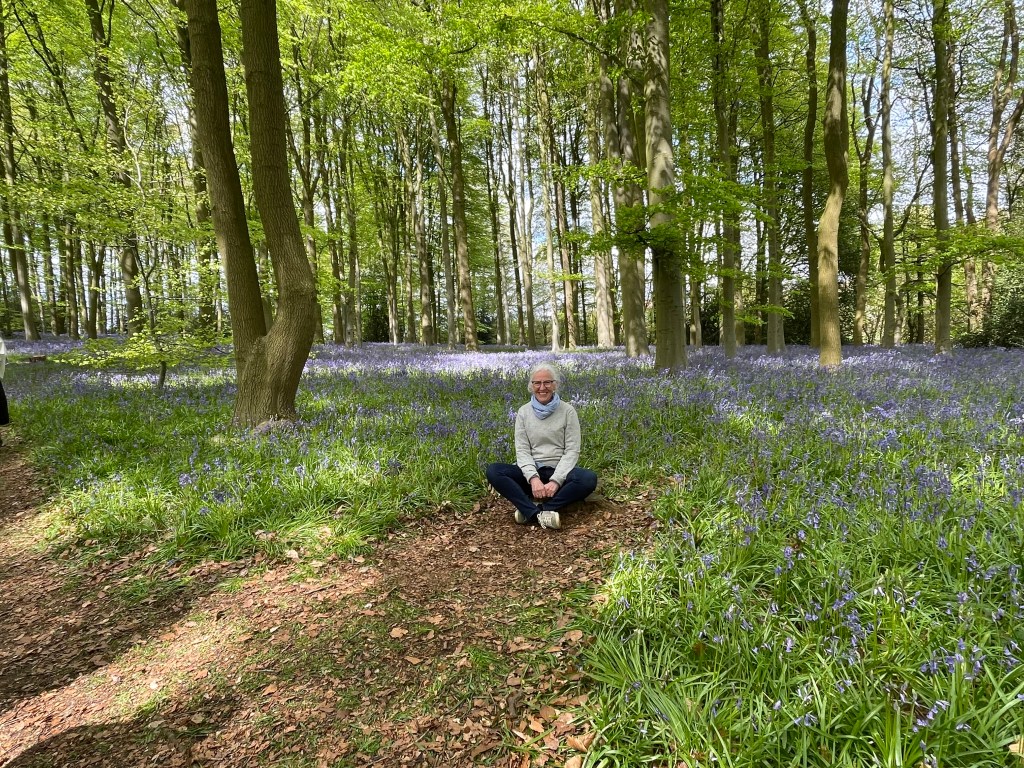
I dreamt the powdered scent of bluebell woods.
If they survive, my daffodils should flower again.
This past fall, I planted fifty daffodils. Settling each with blood and bone meal, not just to enrich the earth, but also to ward off the pesky squirrels. Daffodils are toxic, and squirrels know well enough not to eat them, but it doesn’t stop them from digging up the bulbs, taking a small nibble, then throwing them to one side, when they realize that it’s not a yummy tulip. As I knelt on the damp earth, my Mum‘s voice was by my side, helping me to bury the bulbs deep enough to thwart the squirrels. And from the corner of my mind, I saw my colleague, Barbara kneeling in her garden to plant six hundred daffodils.

I crossed paths with Barbara from time to time. Like me she was a physiologist, we happen to have studied at the same universities in England before she emigrated to the US in 1956, and much later on, I moved to Canada. Like me, although she had worked as a research scientist, she focussed most of her career on establishing criteria to improve the lives of animals used in biomedical studies. We met, for the last time at a conference in Italy in 1999, where she told me she was retiring. I was shocked, although I realize now that she must have been in her 70s. I asked her what she was going to do, thinking she would have some plan to write another book or tackle another issue, instead, she said simply “I’m going home to plant six hundred daffodils”.
and thought to leave my written words, my studies
too, as scattered seeds for contemplating pain
we carried on talking, of course, and she did carry on writing, sending me essays and book chapters to read for her. I never asked her “Why six hundred daffodils?”. Maybe, it was just the number of daffodils she thought would fill a particular space in her garden, but I suspect she had some other, deeper reason.
Since 1956, daffodils have served as the emblem for cancer awareness in Canada. Their bright yellow trumpets, coming after the darkness of winter are a sign of resilience and hope. As far as I know, Barbara never worked on cancer research, and nor did I, but as I settled each bulb into the ground, I wondered whether she planted six hundred daffodils as a reminder to honour the animals she used in her research.
…for contemplating pain
as pain, not just precursor to a trumpet’s crow
of cures for all…
Lately, I have been reading “Orwell’s Roses” by Rebecca Solnit. I never knew that Orwell was a gardener, or that he wrote articles about nature, defending “the intangible, ordinary pleasures, the joy available in the here and now”, to be found in planting and tending to flowers. Rather, I used to think of Orwell only in puritanical terms, dedicated to socialist values of hard work, extolling workers’ rights to earn their daily bread. Clearly, though, he understood the value both of bread as the staff of life, and roses as life-affirming. “Bread for All and Roses Too”. I thought again about Barbara and the difficult work she undertook in drawing attention to the suffering of animals, In the Name of Science. I’m sure that she found joy in the huge task of planting six hundred daffodils, but I hope that they returned to bloom every year, and continued to brighten her days.
I choose instead the flower’s buds
and head for home, work never done, though joy remains.
I plant six hundred daffodils before the snow



 Wandering Wakefield