
by Hilary Jocelyn
As we breathe in questionable air, and witness fires burning near and afar that push people out of their beloved homes, the life-giving value of community becomes more and more important and meaningful. Community is everywhere, and just needs to be built – sometimes by the willingness and togetherness of wet cement, and sometimes by the heaviness and impossible unwieldiness of blocks of grey granite. This is the story of how, long ago on a remote Scottish island, I first experienced its life-changing power.

I wobbled off the bus and followed the other passengers, who were wandering down the hill to a small jetty that lay cowered by an outcrop of craggy rocks, and the wild energetic sea. I dragged my backpack to join them, and then looked over to see the island that lay ahead about a mile away. I am not sure if I had ever, in all my young years, seen anything so mind billowingly beautiful as this distant piece of land that sat glistening and beckoning to me in the afternoon damp.
I waited as the wind played havoc with my unruly hair, and blew its chill through my denim jeans. After a while, a small red ferry boat appeared, bouncing on the savage waves. I clambered on board, along with the handful of other travellers, and parked myself on one of the salt-sodden benches, feeling as I did so, the cold spread of dampness which began underneath me and worked its way slowly from buttocks to thighs, to just behind my knees. With a whirr of the outboard, off we set to sail over the restless water that lay between us and our destination.
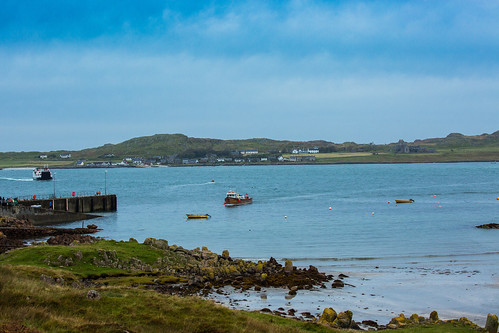
I After about twenty minutes of bouncing, the boat chugged up to the jetty on the other side. The ferryman jumped off and offered out his guiding, gnarly hand to stabilise us all as we disembarked from our salt and water-infused passage. “Welcome tae the Island of Iona “ he said, wearily and without a hint of a smile. “The last boat is at a quarter past five and if you miss it, you will have tae stay the night here.” This, by the way, was my first introduction to Duncan, who, I discovered later, was renowned all over the Western Isles for being a dour and canny boatman, with no time for pleasant facial expressions or verbal niceties. A tough exterior that shrouded a soft and gentle core.
I grabbed my bag and disembarked with the handful of tourists, who wandered up the path onto the one narrow village street on the island. I felt proudly distinctive, as unlike them, I was not here to stroll around at leisure, and take pictures, and read about the amazing history of this place. No, I had come here to be gainfully employed as a cook at the Island’s Youth Camp, which sat up a steep hill, about fifteen minutes walk away, and which was going to be my home for the next several months.
I will try to describe the island to you, but I have a feeling that I won’t be able to properly do it justice, as its magic goes above and beyond what any words can possibly say. How can I explain the single track and almost carless road that runs, littered with sheep, from one end of this island to the other? How can I properly tell you about the hills and the wild deserted places that cover this small land mass, that is only one mile long and maybe two miles wide? Or about the sea, and the wind that never sits still? Or the cliffs that tower above the sandy beaches, keeping watch down below for wild birds, seals, and the occasional small fishing boat? And how can I even try to paint a picture of the one short village street lined with a couple of dozen stone cottages, which house a number of the eighty or so local inhabitants of this paradise-strewn place?
Breathing in the beauty, I wandered up the only road towards the youth camp, lugging my possessions with me. The spell-binding sea air helped to reduce some of the anxiety that swirled around in my brain. I was here to be a cook, but really, in all honesty, my skills in the kitchen were seriously limited. Of course, I knew the basics, such as how to make a cup of tea, or fry an egg, or even to make the odd batch of either soggy or burnt sweet treats but cooking three meals a day for 15-20 people – six days a week, was beginning to feel a bit overwhelming and considerably out of my restricted comfort zone.

I arrived at the camp and saw a collection of simple long wooden huts, with a bigger rounder building in the middle, that housed the main living and dining area, and very importantly, the basic, but gleaming kitchen, that I was soon going to become quite intimately involved with. On the front steps sat a group of teens, who serving as the unofficial welcoming committee, told me that the food the previous cook had made was “ Gallus ” (a Glasgow word that means “impressive”). My confidence took another giant swirl in the downward direction, as I really did not think even in my wildest dreams, that anyone would describe my cooking in that way. I gulped silently, and faking a brave front, smiled cheerfully, and marched forward, up the stairs to face my challenges.
After a few days of stomach swirling and performance anxiety, I realised that it wasn’t going to be as much of a calamity as I had feared. In fact, it was a piece of cake. The pre-set menu and nicely laid out and easy-to-follow recipes were definitely not anything that came anywhere close to being described as gourmet. However, the campers, who came from homes where food was not always very plentiful, were in the main, quite happy to demolish most of what was plopped onto their plates, helped, no doubt considerably, by the appetite stimulant of the fresh sea air.
In the morning, I served porridge and toast, so a no-brainer there. For lunch, it was bread and cheese and a dollop of soup that came out of an enormous bucket-sized tin can, and the simple evening meal was served on a seven-day rotation, so I only really had to learn to create seven spectacular dishes. Monday – Spaghetti, Tuesday – Chilli, Wednesday – Shepherds Pie, Thursday – Sausages and Beans. Friday – Mac and Cheese…. You get the picture. Yes, I had to bake mid-morning treats and experiment with various kinds of sickly-sweet desserts, but the campers were often only too happy to try their hand at making such things, so I got off somewhat lightly, and most of the time, apart from the odd spectacular disaster, and the occasional pot of burnt porridge, I managed to muddle along.
Meanwhile, I was discovering something about this place that was far bigger than the meals I was cooking and the dirty pots that had to be washed. I was learning about the word Community. I was realizing that the real beauty of this place was not just to be found in the visual joys that it served up every moment of every day, but in the depth of the connectedness that developed and formed between the many people who came to stay here on this island.
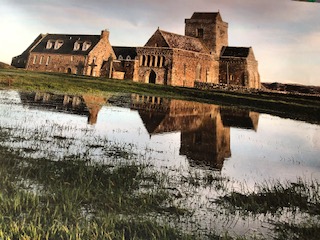
Way back in the hungry thirties, when unemployment was high and spirits were downcast, lots of Glasgow’s skilled and hearty shipbuilders were left floundering with no work, no money, and no sense of feeling proud. A well-respected community leader somehow arranged for several groups of these gifted workers and their families, along with a handful of students (who knew more about books than about connectedness), to come to Iona, where they built simple huts to live in together, and began the mammoth task of rebuilding the ancient and dilapidated Medieval Abbey, that sat in ruins on the shore. This diverse group shared their various, transferrable skills, learning from each other, and getting a chance, once again, to rekindle and stimulate their wounded sense of self-worth, as slowly, but majestically the old stone ruin rose up from the ashes.
The old wooden huts were then transformed into a basic Youth Centre, with its leaky roof and squeaky bunk beds, so that groups from economically disadvantaged inner-city neighbourhoods were able to participate in this beautiful place, and spend a week or two living together, while enjoying the backdrop of Mother Nature’s astounding gifts. While I was there, stirring the porridge, dolling out soup, or gasping at the view of the sea from the camp’s doorstep, I witnessed countless, generous examples of people living in community and helping each other.
A typical group might be made up of…perhaps half a dozen lively young lads who were usually locked up in a Young Offenders Institution, a handful of single mums, and their lovely wee bairns, a few people using mobility aids, a couple of folks living with Downs syndrome, and perhaps one or two people who were dealing with complex sobriety issues. The island was “dry” and as there was no easy way to ‘escape’ the Scottish Penal System approved heartily of this ground-breaking project.
Yes, there were definitely more than the occasional worrying and nail-biting dramas, but more importantly, every day, delicious harmony, and stomach-clutching laughter made the roof swell, not to mention my heart. What a privilege to see a young lad, usually condemned to a cell, singing out loud as he pushed a new friend in his wheelchair. Glee and delight, exuded, as his self-image shifted from being labelled a “criminal” to being someone who can help, and enjoy, and share his unique gifts, while his new friend showed him a thing or two about how to sing like the “Backstreet Boys”. And certainly, magic crept in when someone who had been overwhelmed, and crushed to the bone for many years by the power of alcohol, connected tenderly and wonderfully with some of the young children. Because here, in this place, they had discovered their precious sanctity, as there was literally, nowhere to access the temptation of booze.
I too found healing and peace among the island’s hills and stormy weather, and I went back to the city a very different person at the end of that Summer, carrying on my shoulders, the goodness, the struggles, and the adventures of this deeply meaningful place. I returned regularly to work, or to visit, and to receive the life-giving injection of Community. Of Sharing. And of Caring.
But real long-lasting, and durable gift from Iona, is that Community is Portable. It doesn’t just exist on a remote Scottish island, but it can be created, intentionally, or casually among friends and neighbours, wherever we are in our lives. Those unemployed shipbuilders of the 1930s, and the rest of the crew, didn’t just stay on the sacred island where they could watch the incoming and outgoing power of the tide. They went back to their own inner-city communities, and carried on the sometimes teeth-grinding, hair-pulling-out and perhaps exhausting task of bringing different people together, to help each other, and to find a common thread.

Thank you to the to the Communities that we now all live in. To Wakefield and Beyond and Everywhere Else . And, a big shout out to the work and creation of the Mutual Hills/ Collines Entraide Group, and other similar initiatives that are now bursting forth, with the aim of building community, and helping each other in our times of need.

 Wandering Wakefield