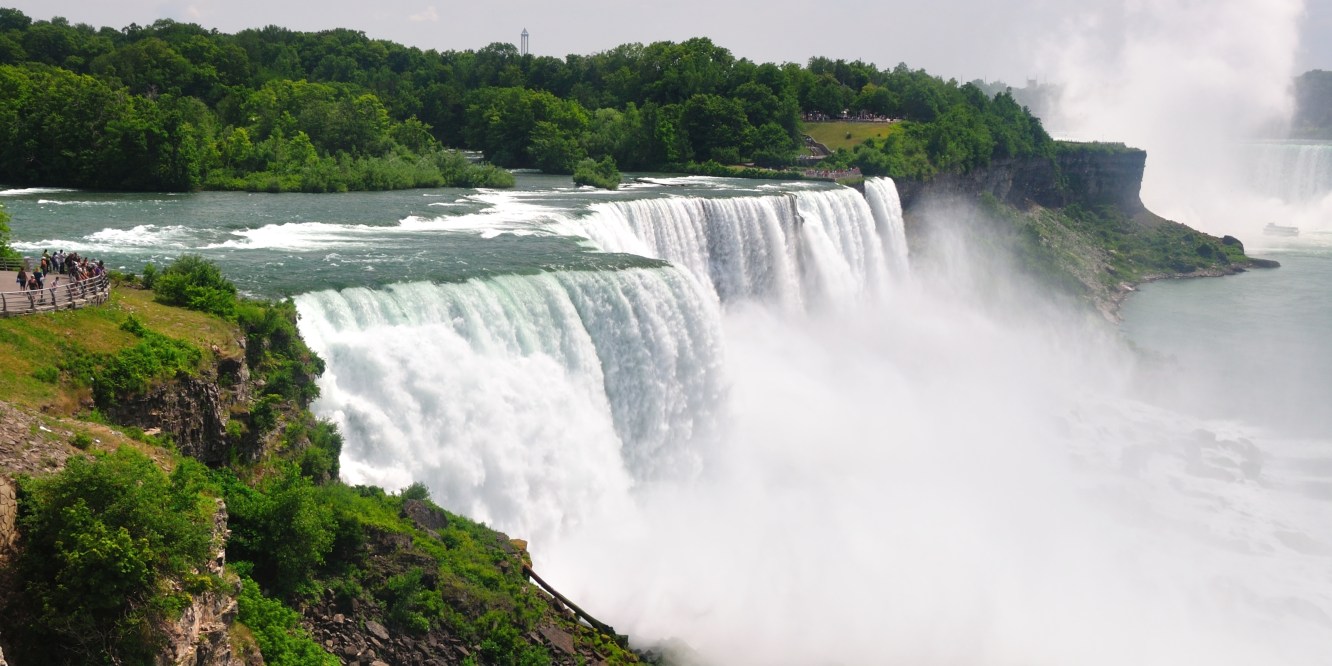
Last week I attended an international congress held in Niagara Falls, Ontario. The tagline of the scientific meeting was “over the edge”, meant, I think to symbolize that this was the gathering that would finally push to a new stage, a new era. It’s a powerful image. The massive waterfall. Once you have committed yourself to going over the edge there would be no going back.

Because of this image, leading up to the meeting I found myself thinking about edges. What does it mean to be “on the edge”. Why is it such an uncomfortable space to occupy? Maybe because in the blink of an eye, something, anything, your entire world, could change dramatically
The lake at night is the black hole
Of dreams.  No borders
I stand at the edge
Of a cliff at the edge of this world
I dream of falling
Almost 50 years ago, I sat in a lecture theatre at the University of London to listen to Sir Eric Ashby, then Chancellor of Queens University, Belfast. I vividly remember him asking us students what type of scientist we intended to be. Would we be content to crawl along the frontiers of science with a hand lens? Or would we become a paradigm hopper – someone who pushes, takes a leap of faith, a risk, and looks at things through a different lens? At the time, I was determined to become a paradigm hopper. I could not see myself being content to carry out one carefully planned and executed experiment after another to test the same hypothesis.
I think it’s fair to say I’m neither careful, nor patient, but little by little over the years, I’ve started to value the work at the edge. For one thing, it makes you slow down, and maybe appreciate finer details.
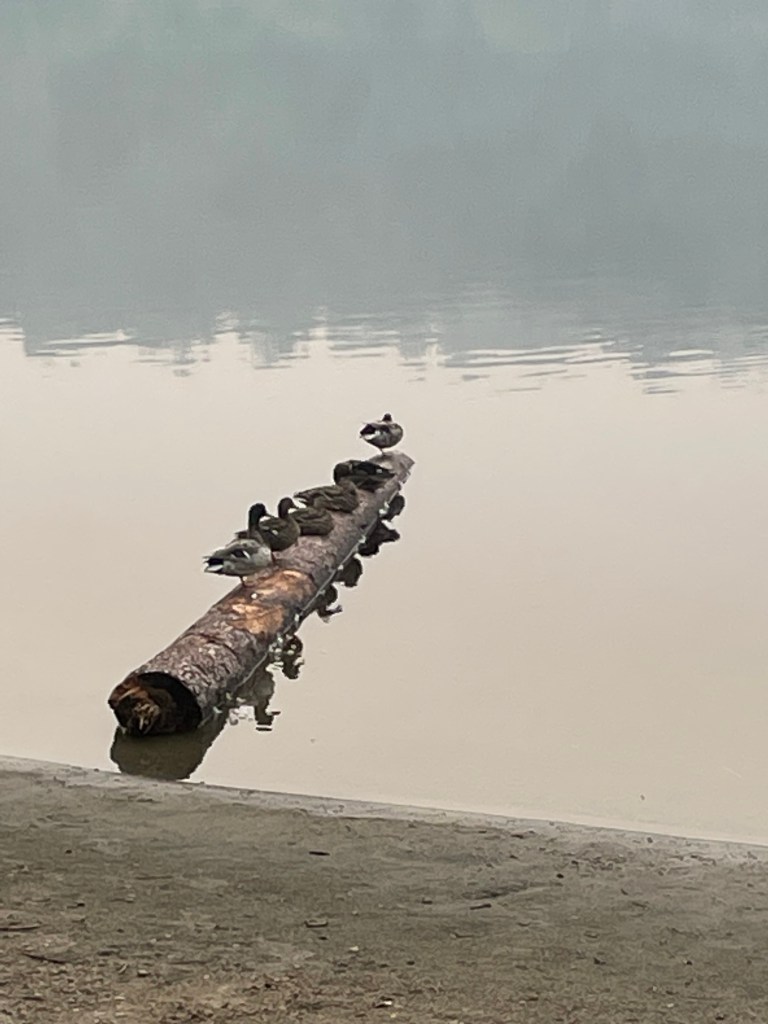

I’m not a visual person, so my morning walks with my dog are more about thinking than seeing. But when Russell stops to sniff the morning air or to check the pee-mail on a tree, I find myself taking time to look around. Lately, it has been edges that have consumed me. I stand at the edge of the river, never the same one day to the next. The level of the water is higher or lower, the edge of the water well defined, or lapping back and forth with the wind, or waves caused by boat traffic.
In high school I was taught (somewhat incorrectly) that atoms are comprised of protons, neutrons, and electrons, but mostly empty space. I remember that it freaked me out. I began seeing objects around me as impermanent, where the edges might bleed into adjacent objects, including me. While that might be a somewhat naïve view of atoms, there is no definite edge to an atom. It still bothers me that there is no edge to anything.

Wandering along the river and wandering by the falls, edges blur and disintegrate. They are not to be trusted.
The edge of Niagara Falls is moving upstream at the rate of approximately one foot per year. Apparently, even when an edge seems permanent, it is constantly in motion. I repeat, edges are not to be trusted.

So recently, walking through the woods I’ve been looking at the edge of things more carefully. It’s mushroom time. I watch them appear, take up their place for a few days, and then slowly begin to disintegrate. The edges fray, become more edge, become more vulnerable.


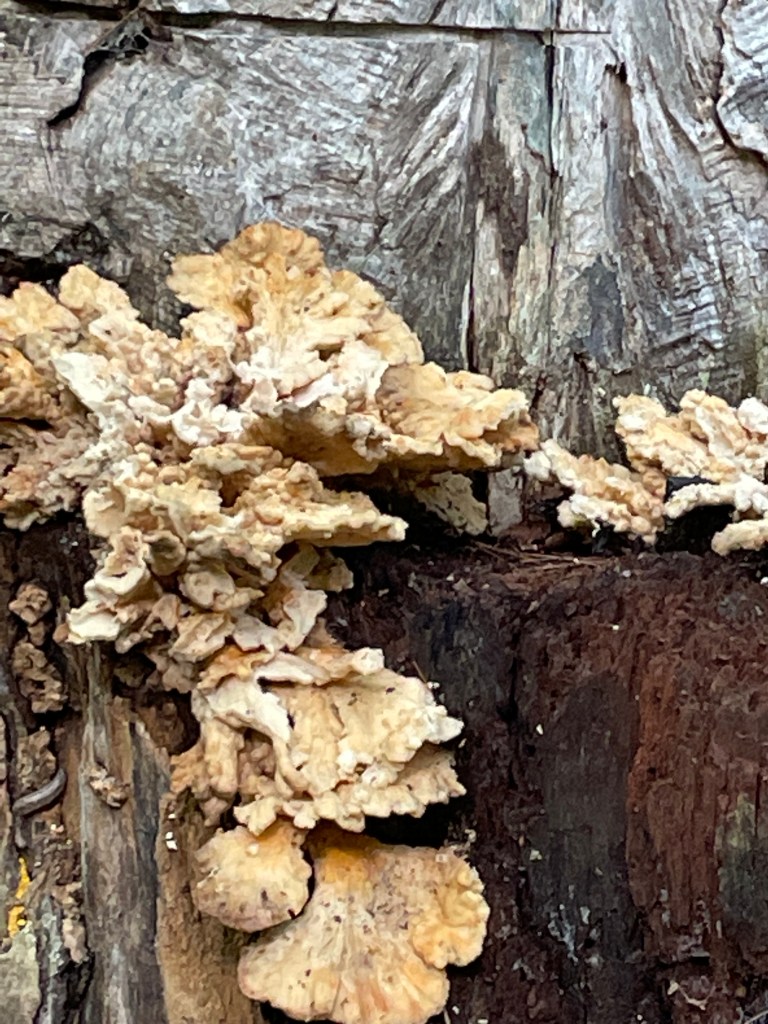
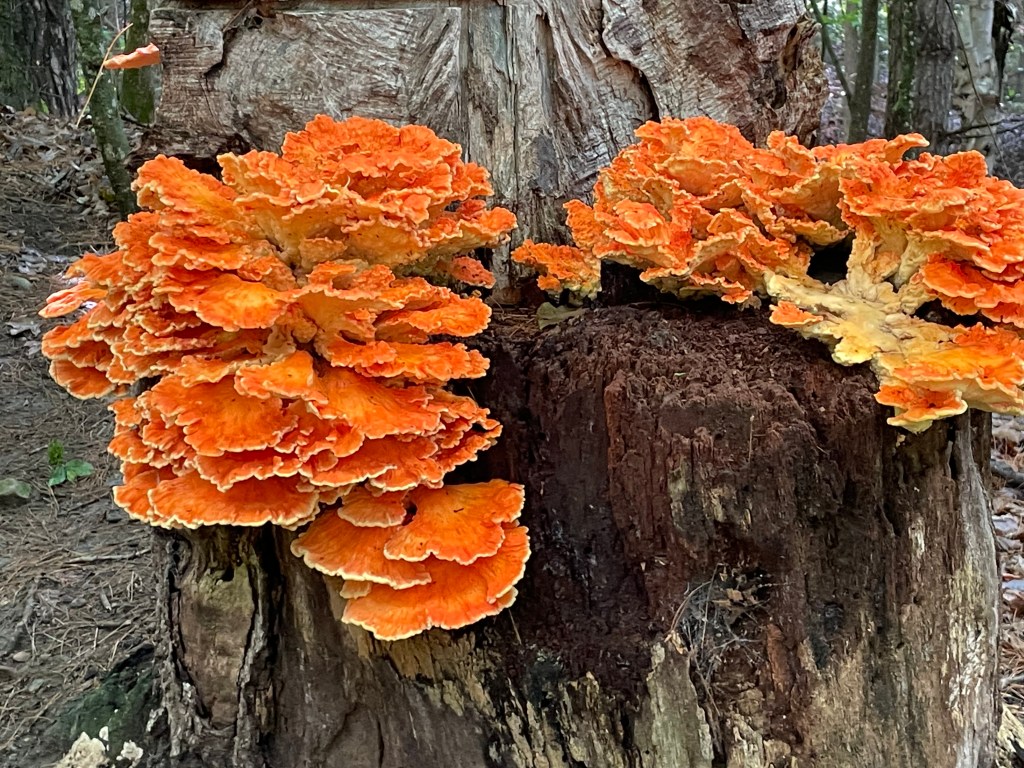

At the end of the meeting in Niagara, I was uncertain about leaping over the metaphorical edge. Instead, I found myself unsure of where the edge is, no longer sure whether edges exist at all.
Wandering with myself and my dog, through the village and the trails, problems have a habit of resolving themselves into lines for a poem. But not this time. Instead, I was reminded of a poem I heard read by Mary-Lou VanSchaik and Ilse Turnsen at a recent poetry/music event in our community library (Monet Refuses the Operation, by Lisel Mueller). Because of copyright, I can’t reproduce the poem, but I hope you will click on the link, and read it for yourself. Below are the lines that spoke to me
I tell you, it has taken me all my life…/to soften and blur, and finally banish/ the edges you regret I don’t see,/to learn that the line I called the horizon/does not exist and sky and water, /so long apart are the same state of being…
(excerpt from Monet Refuses the Operation, by Lisel Mueller, In: Second Language (Louisiana State University Press, 1996))

 Wandering Wakefield