
By Kimberly-Anne Ford
Dedication: For Phil, ever inspiring.

My winter morning ritual begins with a cup of Bean Fair’s Wakefield Blend, savoured in a plastic chair perched on my deck, overlooking the Vorlage ski hill. I am bundled in my parka and a blanket, but really needn’t be. The cars in the parking lot are a hefty stone’s throw away, the swooshing of skis and boards audible over the Norah Jones whispering through my patio door that has been left open a crack. In the evenings when there is night skiing, a brilliant light show illuminates our dinner table, casting wintery cheer through our windowed façade. But, it is the mornings I like best. I can spend minutes or even hours trailing, with eyes focused beyond the thicket of trees, the brightly clad daredevils bouncing over moguls or little tots all bundled up and taking a hesitant lead on what can only be described as a leash tethered to a patient and encouraging parent.
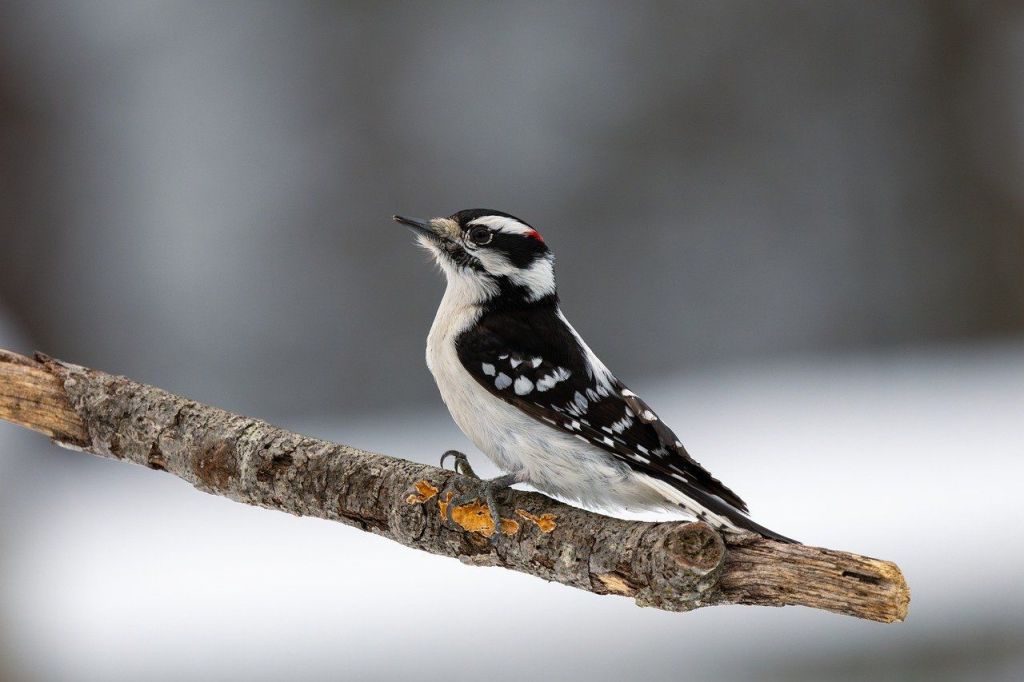
A downy woodpecker taps the beat on an old maple, an immovable feast for him and his friends. Sometimes the great pileated makes his appearance, pecking so hard and so persistently that it is a wonder he can keep his senses. But, unharmed, on he moves to the next feeding perch. I have often marveled at the wildlife that graces our property, my forest family. I tell my city-dwelling friends, “I’m walking distance from the pub and yet have stumbled home to find bears feasting on my apples.” It is a gift, to be immersed in nature. The February sunshine that kisses my cheeks is also a gift. I love a sweltering July day, but there is something special about the rays of winter. A frigid afternoon can be glorious with the sun on your face, heightening mood and infusing therapeutic Vitamin D during the dark months. I find myself adhering to the singer Xavier Rudd’s melodic advice to “Follow, Follow the sun,” and strive to make my way outdoors when its brightness shines through my southern facing windows.
A voice is clear above the din of the ski hill’s muted noisiness. “Mamma, j’su pas capable!” cries a young boy. It becomes clear the tike has fallen over and can’t get up. Then, laughter, the other common feature of the soundscape. Winter, it seems, is much about overcoming. And when we do overcome, it is such a joy. Whoops, cheers and giggles are the musical backdrop for my morning java.
As on so many bright, crisp days, I feel the drive to get into the action. To observe, but from a closer perch. To move my body and feel my lungs breathing in cold clean air. Whenever a new friend sees my house, the first question they always ask is, “Do you ski?” The answer is I have not stuffed my feet in a pair of rigid downhill ski boots since my kids graduated from the green bunny hill and left me in a pizza stance in the powder by myself. I could blame my ailments, or the cost, but the truth is, I’ve never liked downhill skiing. Too much time spent in a line or on a lift, done with a run in mere minutes. I have, mind you, loved the après ski, observing families coming in from the cold, clunking around in their moon boots, shaking snow from their sleeves, kids all rosy-cheeked and full of excitement at their accomplishments on the slopes. Being part of the action, without participating in the action, being a participant observer.
Not quite a voyeur in life, my training as a sociologist has honed my tendency to remain on the sidelines. This is an exaggeration, granted, but I do often find myself quietly observing. I know I’m a good listener and keenly observant, but sometimes I need a push to dive in. The participant observer immerses themselves in a group or social setting, but remains on the outskirts, observing participants’ behaviours and interactions to understand a culture, belief system or practice from the participants’ perspectives. Never was this capacity of mine so well utilized as when I held the position of defence scientist, hired to formulate analyses on the quality of life of military personnel in the Canadian Forces. There I participated in mess rituals, lived in deployment camps and had endless conversations with member of the Canadian Forces, all in the hopes of understanding, and maybe even improving, their quality of life. My capacity to blend in, but to remain on my own has always rewarded me with rich data that augmented not only my research study, but my whole being. I build connection and grow from it, although I may appear standoffish.
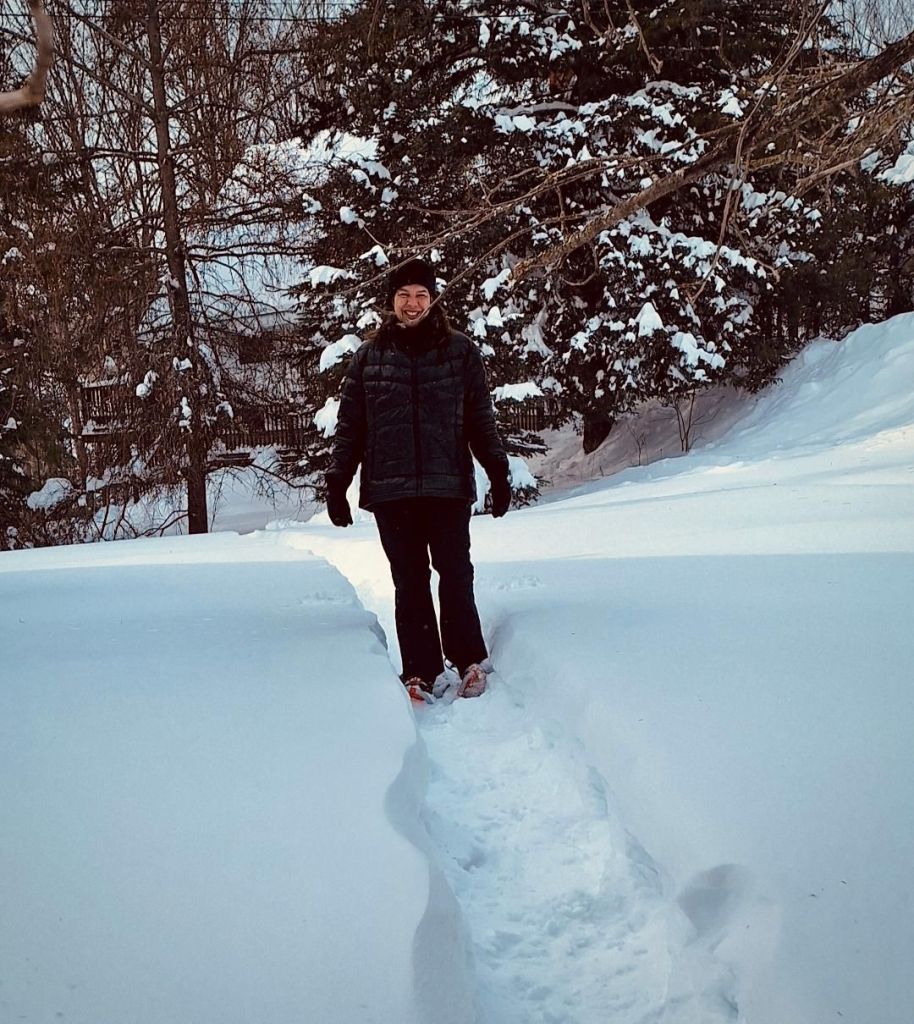
I thread my legs through my favorite winter garb, a pair of black snowpants found at the vintage shop. I have been called a winter ninja by my friends, because all my winter gear, from toque to boots, is black. This is by happenstance and not by design, finding an item here, thrifting an item there, the whole dark outfit accidentally created, not planned.
My snowshoes are always at the ready on my front porch on top of the woodpile. I start my trek by tracing a path from the front of my house to the back, tamping down the area around the fire pit and following the well-trodden deer tracks back to the front of the house, a domestic circumnavigation. The markings of my woodland wildlife cousins always bring a smile to my face and I feel a sense of pride that they share my appreciation of these surroundings.
The snowshoes come off for the short walk up my road to the place where neighbours have cut a track through the woods. Careful not to get stuck in the deep snow, or to fall and not be able to get up like the little guy I heard earlier, I hoist myself up the snowbank and over to a place where I can put the snowshoes back on. A few steps in I note the signs beckoning trespassers to keep off the private property. I dismiss them, since I am, of course, a local. A landowner, even. In my mind it is my right to be there. The Five Man Electrical Band said it well, “Hey! What gives you the right? To put up a fence to keep me out or to keep mother nature in.”
A long steep descent brings me down to the half-frozen holding pond, where the ski hill gets its water for snow making. A track has been traced by some kind of machine, for people to do back country treks, should they share my aversion to chairlifts and moon boots. Diversification of products and services keeps the ski hill afloat. Or so we hope. Murmurs of land sales for development whisper of a Plan B for its new owners. But it seems to many that the ski hill, now a veritable four-season outdoor sports centre with the addition of mountain biking, will eschew the encroachment of condos in the area.
Some wilder trails wind through the woods away from the pond, but I decide to keep trampling the well-worn path to see if it will eventually get me close to the action on the ski hill. Chickadees never seem far from my left shoulder as I twist, climb and descend through the well-packed white stuff. My body feels alive in a way that it doesn’t in other seasons. My inner furnace is keeping my temperature constant in the wake of the cool gusts stirring the top layer of powder from the banks. The snow on the path is like thick merengue, beaten stiff then baked until a crispy crust forms, crunch crunching under my feet. That crust supports my weight, making each footstep surprisingly effortless. For a challenge, I dabble over to the side of the track, where the snow is like fluffy whipped cream, giving way to my every step. A very long steep hill awaits me up ahead. Part of me wants to turn around. What if I fall on the way back down, I think. Then I chide the old lady inside my head, reminding myself to never be afraid to go up an incline for fear of coming down. You can always go down on your ass, I tell myself.
Perching at the top of the ascent, after a few huffs and puffs, has me reaching for my water bottle. I take a deep breath, inhaling the beauty that surrounds me. Having reached the summit, one step by an arduous step, I am flanked by a rock cliff beyond the trees. Birdsong and laughter from the nearby bunny hill are on the setting’s playlist, but I am nonetheless filled with an utter sense of peace and solitude. I rest a moment or two, counting my blessings. I remember when I lived in cities –Montreal and Ottawa– I would be plagued by seasonal affective disorder, perpetually SAD. I tried many remedies, but none had greater effect than getting outside. We tend to forget that Shinrin-yoku, or Japanese forest bathing, the simple act of spending time in a forest, can have therapeutic effects in the winter as well. I would argue that the dark months are when we most need this practice. Energies mix in the forest, breath meets breeze and the body is nourished on a molecular level.
The sounds of the ski hill are just up ahead through the trees, so I move on, grey rock face on starboard all along the way. The trail gives way to the Green run, the easy slope where beginners go to learn. Some take their snowboards here for their first spins, getting accustomed to having two feet firmly glued to one board. Parents follow their tots as they learn the controlled twists and turns that will keep them from flying headlong down a mountain. The practice of putting your kids on a leash to teach them to ski wasn’t the thing to do when my daughter was learning, but I recall with a smile how we glided down this very bunny hill with her in a hoola hoop, encased in my elongated grasp. I observed teens racing each other down the hill, taking jumps on its flank. I marveled at the older woman moving in slow deliberate wide turns, with an ear-to-ear grin on her face. I stood there for a long time, taking in the fun, taking in details about a cool item of gear, or a neat technique. My favourite sight was the thirty-something couple in matching bright red jackets, snow ploughing down side-by-side, linked by holding onto each other’s outstretched ski pole, chatting away as if they were the only two people on the hill. I take it all in, standing on the sidelines, part of but apart from.
The truth is, I am deeply connected, fully enmeshed in my environment and in the natural world. I am reminded of late-night, philosophical conversations with my ex-husband Bill on the work of post structuralist philosopher Gilles Deleuze. Much like grass grows through the exchange of energies in sub-terranean linkages, those linkages remind us that we are all related, and impact upon each other through the mere state of being. So it is during the forest bath. Forest bathing is a sensory experience, an embodied connection to the natural world. Japanese studies have shown forest bathing improves sleep quality, mood, ability to focus, and stress levels. But I think forest bathing is also a political act. By experiencing and enhancing my connection with nature, I confirm that I am part of her and thus her preservation is my very own preservation.

As I make my way back home on a winding path through the woods, I feel the breeze on my face, talk to birds on the bough, and am enveloped by the branched-out arms of the forest. I near the long steep hill that will lead me back home, and I do contemplate sliding down on my rear end, but instead let gravity pull me into an awkward gallop to the base. Deer tracks cross the passageway, as they do my property. When I see these markings, I like to think they are made by my kin, beings that share my turf. We are all deeply interconnected, humans and nature, although that connection can seem severed by the busy business of being productive.
From the days of the Industrial revolution our wild energies have been suppressed so that we may become productive working beings. The rise of the scientific method and writings about the norm has had the effect of severing human’s connection to the natural world by identifying that which is strange or wild as “deviant”. The Canadian philosopher Charles Taylor speaks of following the voice of nature inside us as being the key to ending the environmental crisis. We are stuck, Taylor says, in a “cult of individualism,” which sees the world as made up of distinct entities. This lends itself to the position that society and nature are distinct. The energy that connects all living things, however, makes us literally co-extensive with the natural world.
Carrying my snowshoes up the road, my white house with the apple trees that will soon attract all walks of furry friends comes into view. As I often do, I count my blessings. The participant observer, is, first and foremost, a participant. My place in my community (including the broader community of non-human beings) is in part shaped by my actions. We are taught in the social sciences that even our observations have an impact on those observed. I know how fortunate I am to live where I live. Every day the participant-observer in me is busy contemplating how I can make my impact positive, to show my gratitude and even from where I am on the sidelines I am thinking about making a difference.
Wildness is celebrated in my community: in the anti-war protest dances on the boardwalk, the hanging of red dresses from tree boughs, and in solstice celebrations around a blazing fire. I have examined my role in my community and in the broader society and have tried to do my part to, if not make things better, then at least to not make things worse. I know what it means to be grounded in place.
I kick off my boots and walk into my messy kitchen, the breakfast dishes left beside the sink. After slightly heating the morning’s leftover bacon grease, I pour the lukewarm fatty liquid into a small compostable plate and then sprinkle oats over the oil until they soak in. Back in the sunshine, I offer up my gift to my feathered co-inhabitants. A fat jay comes to feed almost right away, and I observe from my perch a flutter of contentment. Apart, but part of. On the outside, in.

 Wandering Wakefield