By Paul Hetzler
According to legend, a few individuals have kept the Tower of London, as well as the British government, from falling since the mid-1600s. That’s pretty good for a bunch of bird-brains. And I’m not talking about politicians – these are ravens.
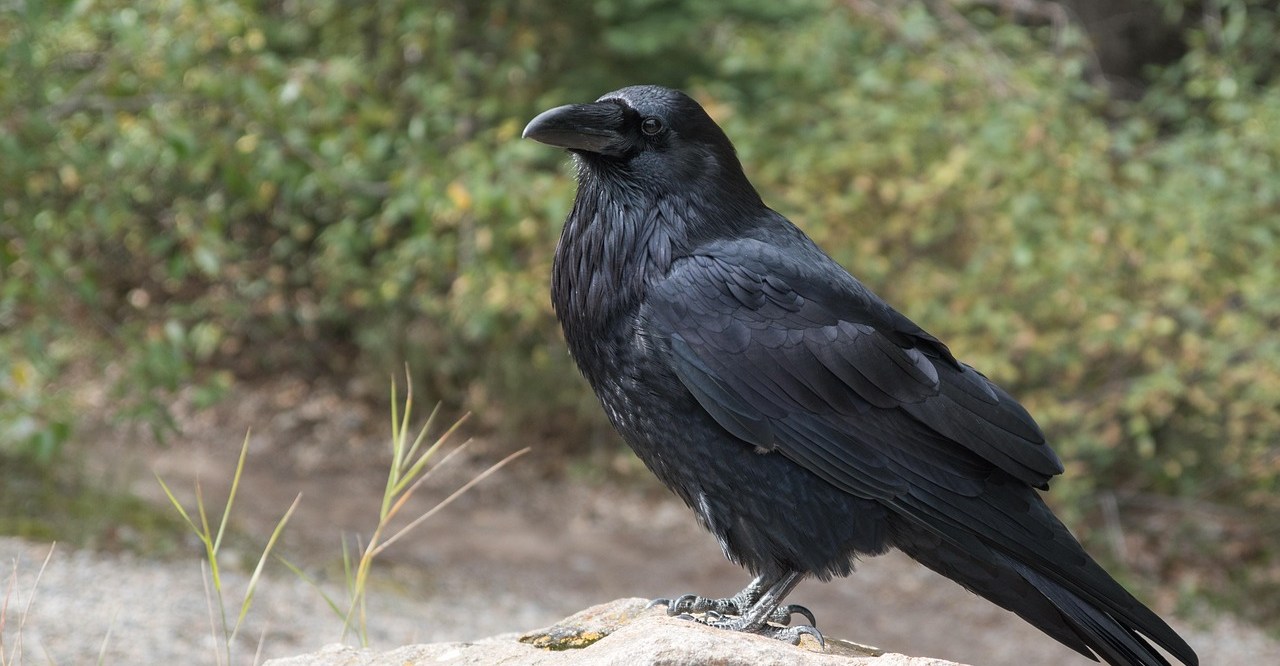
Native to most of the northern hemisphere, common ravens are anything but ordinary. They have an intellect on par with that of chimps and apes, and are able to plan for the future better than four-year-old humans can. They’re known to use tools, and to make sleds and snowboards for winter-sports antics.

And yes, a flock of ravens has been kept since the reign of King Charles II in the Tower of London to keep the thing upright. Apparently, a sage advised Charles II to keep at least six ravens at a time to ensure the tower stayed upright. Maybe engineers were in short supply back then. The tradition was bolstered in World War II, when the fact that the tower remained unscathed in spite of heavy German bombardment led some to feel that ravens were in fact protecting it.
In North America, ravens can be distinguished from crows by their size. On average, ravens are 63 cm long, and weigh about 1.2 kilos. Wingspans are in the neighbourhood of 152 cm. In contrast, their close cousins the American crows measure about 46 cm long, and weigh around 500 grammes, with an average wingspan is 94 cm. Ravens also have rough feathers on their throats, and on the upper surface of the base of their bills, features lacking in crows. And unlike crows, ravens do not migrate for the winter.
Their call is more guttural than that of other corvids. I imagine it’s like a crow would sound if it smoked two or three packs a day. Not that I’ve ever seen a bird smoking a cigarette. Ravens also make a range of clucks and resounding tocks that carry a good distance. Some people have reported them making a very low growl.
Ravens also prefer more elbow room than crows do, favouring rural, often remote, environments. They like to nest on cliffs and rock ledges or in tall trees, although human-made structures like bridges and utility poles are sometimes used. Ravens mate for life, and both males and females help build nests and care for the young together.
Known for their aerial acrobatics, ravens have many times treated me to these performances when I was out hiking, or even just working in the yard. They’d swoop down silently into my line of sight, where they’d barrel-roll and tumble in the air before disappearing again. Ravens are one of the few bird species known to play games with mammalian species like otters and wolves. In addition, they are the only documented bird that chooses and fashions objects whose sole purpose is to use as toys.
There are at present six recognized subspecies of Corvus corax. These birds have been under the figurative microscope of late for reasons other than to find if they really do keep the Tower of London in a vertical position. Biologists set about to quantify how smart ravens really are – which is very.
In studies conducted between 2015 and 2017 at Sweden’s Lund University, researchers found that ravens were more adept than chimpanzees at problem-solving tasks. And that they were better than human four-year-olds in planning ahead to obtain a tool necessary to open a box containing treats. In the words of Mathias Osvath, a raven-cognition expert at Lund University, “I’m a little bit surprised they were that good. Monkeys have not been able to solve tasks like this.”
The same research team also tested ravens’ ability to barter, and found they were quite disciplined at trading tokens for a high-value treat at a later time rather than for a common treat in the moment (yet another reason to drop the moniker “common” raven, I say). They were considerably better at delaying gratification than any great-ape hominid previously tested.
An international study done in 2016 proved that ravens could think in the abstract. Ravens inside a closed room would hide food if a small peephole was open, but not when it was shut, indicating they could imagine being spied upon. It could also be evidence ravens are somewhat paranoid, though, but I don’t think that was the point.
Perhaps the most significant finding is that ravens showed evidence of displacement, the ability to relate information on events removed in space and time. While young ravens roost communally but disperse each morning to forage, if a lone juvenile reports the presence of a food cache guarded by adults it saw that day, the following day, young ravens may organize to drive off the adults from the food source. I suppose this could be a sign of juvenile delinquency as well as the ability to plan for future events. Ravens are now the only vertebrate known to share this trait (displacement, not delinquency) with humans.
Along with their corvid cousins the magpies, rooks, and crows, ravens pilfer and cache shiny objects, often coins. No one is sure if this is curiosity, or whether it is to gain status. My son, whose name is Raven (true story), happens to be a teaching assistant in the Economics Department at the University of Massachusetts at Amherst. He offered this alternate explanation:
“Ravens and other corvids hoard coins because they are gold-standard holdouts who don’t believe in fiat currency. These birds historically opposed the printing of dollars not backed by gold reserves, and today refuse to use paper money on ideological grounds. They prefer precious metals, but have a hard time telling precious and common metals apart – hence they take any shiny coins they can get.
“The exception is rooks, who are all chartalists – they believe the value of money is derived from the government’s willingness to accept it in payment for tax debts. These birds will always take a bill with higher face-value if given a choice. Rooks are naturally law-abiding and are in fact one of the few bird species that pay their taxes every year. Of course, both of these monetary theories are for the birds.”
I’d say that’s a very uncommon Raven.
Paul J. Hetzler
Arboriste certifié, Société internationale d’arboriculture depuis 1996
ISA Certified Arborist since 1996 #NY0430A
Read more of Paul Hetzler at The Saturday Evening Post and https://www.northcountrypublicradio.org/news/reporters/181/paul-hetzler

 Wandering Wakefield