Written by Paul Hetzler
Europeans weren’t entirely inept at naming New World plants and animals. For example, they called a large brown bat species the “big brown bat.” Kudos for accuracy, I suppose. A few labels missed the target, like the native sunflower dubbed the “Jerusalem artichoke,” even though it’s not related to either the Middle East or artichokes. Some names are partly right: the tufted titmouse has a tuft, but it’s a songbird, not a mouse.
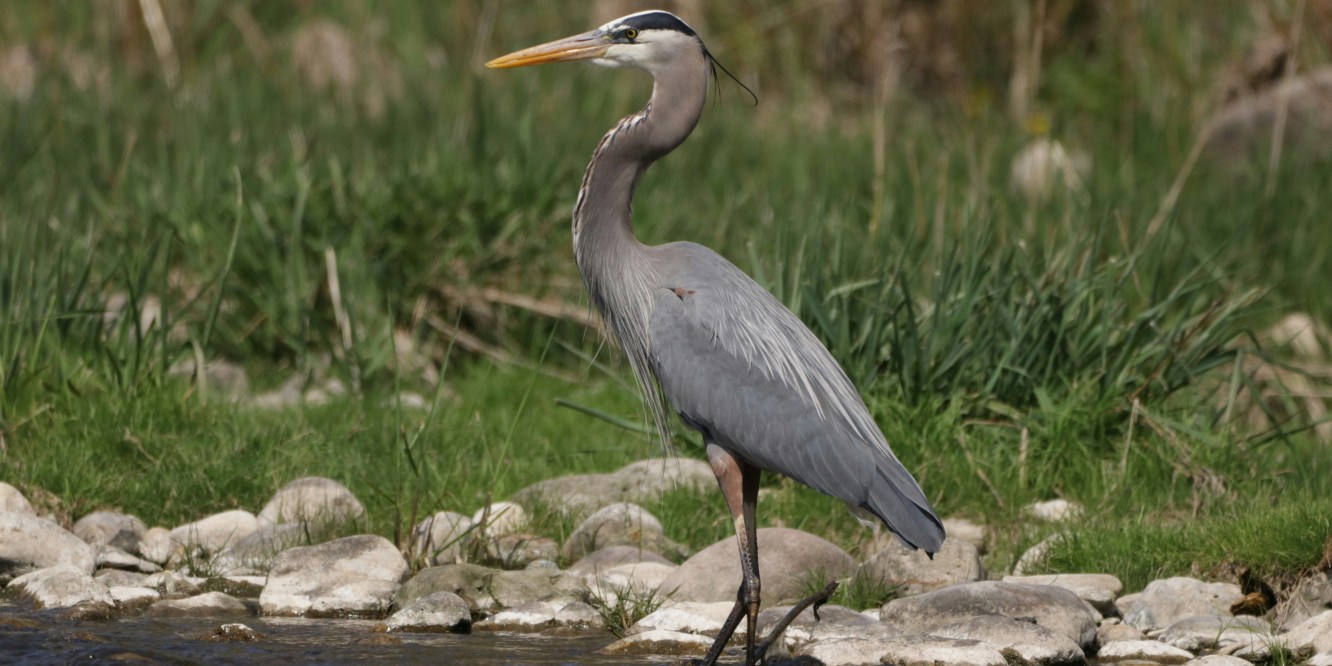
And the great blue heron (Ardea herodias), the largest North American heron, is definitely great, but if you’re thinking cerulean or cobalt, you’ll be disappointed. Some are more brownish, and one subspecies in Florida is all-white. But hey, two out of three accurate names ain’t bad.
To be fair, most great blue herons in our part of the world are primarily a light grey-blue colour at rest. When they take to the air, the darker blue flight feathers are exposed, showing off their snazzy two-tone flight suits. Juveniles tend to dress entirely in drab blue, but adults sport a bright orange-yellow beak, a white crown and a dark head crest.
Obviously they’re big, although females are about 10% smaller than males. The great blue (heron, not whale) ranges from 114 to 137 centimetres tall, with a wingspan between 168 and 200 cm. Weight can vary from 1.8 to 3.6 kg.
Great blues are found throughout most of North America depending on the season. Their breeding range can extend well into northern Canada, close to the Arctic Circle, while their winter territory encompasses most of Central America. On the Pacific coast from Alaska south to Mexico and across the southern half of the US., herons can be found year-round.
One of the reasons great blue herons are so widely distributed is that they are generalist feeders, making them highly adaptable. Their menus range from fish, frogs and turtles (which I’d love to know if they ever swallow whole) to insects, small mammals and water birds. Great blues hunt mostly in freshwater environments, but are at home in saltwater marshes and tidal pools as well. In fact, they sometimes frequent Caribbean islands as far south as the Lesser Antilles.
Equipped with harpoon-bills and impressive reflexes, herons are well-suited to hunting. But their bills are also used affectionately during courtship, to communicate (bill-snapping), and as you might expect, for protection.
Ages ago I became licensed by the New York State Department of Environmental Conservation as a Wildlife Rehabilitator. In the study guide for the written exam, one item that became etched into my mind was a graphic of a heron stabbing someone in the eyeball. Yeah. Turns out you have to cover an injured heron with a blanket before you pick it up. So whenever my daughter, whose name is Heron (really) picks up scissors or another sharp tool, I always afford her an added measure of respect.
Great blue herons start breeding in their second year, and if they live to their species potential, might continue for another fifteen years. They are monogamous during each breeding season, but get to “remarry” every spring.
The preferred heron nest location is high in a mature tree in a wetland. In our region this often means a dead tree within a beaver pond. In remote areas, human disturbance is more likely to disrupt their reproductive success, though herons have been known to acclimate to highways and other human infrastructure. They nest in groups, occasionally with hundreds of nests in a single colony. Apparently the correct term is a heronry, though I had always called it a rookery. In technical parlance, these nesting sites are “wicked cool.”
The coarse, unkempt nests of sticks are striking to behold, ranging from 130 to 170 centimetres across with depths of 50 to 80 cm. Generally, the nests are used year after year, getting refurbished every spring. If you ever take the 416 down to get on the 401, there is (or has been, at least, for the past decade) a heronry immediately south of where Glen Smail Road passes over the 416. Egg clutches vary from two to six eggs, with more in the far north to compensate for a lower chick-survival rate. In southern Canada, the number is listed as “between 3.9 and 4.1,” which I would call “four.”
Since herons return to their nests by dusk, you can surmise the direction of a heronry by watching the direction it takes. If you are fortunate enough to find a heronry, bring binoculars and keep your distance. You may be treated to the return ritual when adults (both males and females incubate eggs and feed the young) return to the nest.
Adults may touch bills with their mate in a show of affection before lovingly barfing pre-digested fish and frog mush into the open beaks of their babies. I have seen the young waiting for dad or mom to come back with carry-in food, their beaks pointed upward and waving gently like some strange nest-grass blowing in the wind.
For many years I lived on a beaver pond-studded piece of land in the St. Lawrence Valley. It had two distinct, though small, heronries, and a few herons would wing by each evening near dark and let out their alarm call, a guttural “gronk” (sometimes translated as ‘fronk’ or ‘bronk;’ linguists are still puzzling it over), as they passed. But herons have a broader repertoire of voices. They coo and cluck to each other on the nest, and clack their bills.
Another cool fact is that within the Haudenosaunee (also known as Iroquois or Six Nations) Confederacy, the kinship system of three of the nations – Seneca, Cayuga and Onondaga – include the Heron among their clans. Herons also mark the seasons for me – I take note of the first heron sighting in the spring, and of the last time I see one in the late fall or early winter.
Even though great blue herons are big, weapon-wielding birds that surround themselves with water, they still fall prey to eagles, hawks, and great horned owls (which also rate a two-out-of-three name accuracy). Since herons are a top or near-top predator, they are also vulnerable to environmental toxins that get magnified at each level of the food chain. Human disturbance and habitat loss are other challenges faced by herons.
In the past they were frequently shot for the same reason that road signs get shot – they are big targets that even a fool can hit – but this is a lesser threat now. In spite of everything, the Audubon Society lists their population as “probably stable.” I hope that’s an accurate report.
Paul Hetzler is a former Cornell Extension educator living in Val-des-Monts, Québec. He usually capitalizes ‘Heron.’
Arboriste certifié, Société internationale d’arboriculture depuis 1996
Read more of Paul Hetzler at The Saturday Evening Post and https://www.northcountrypublicradio.org/news/reporters/181/paul-hetzler

 Wandering Wakefield