
I shall be telling this with a sigh
Somewhere ages and ages hence:
Two roads diverged in a wood, and I—
I took the one less traveled by,
And that has made all the difference.
Robert Frost wrote those lines over 100 years ago, in 1915. They have been ingrained into the psyche of schoolchildren everywhere, used as justifications by psychologists to navigate the rocky road, and justified reasons for not following the expected route, such as university, marriage, career, or whatever the case may be. In reality, Frost wrote those lines for his friend, fellow poet Edward Thomas, with whom he often went walking. Thomas was indecisive, could never make up his mind about anything, least of all which path they should follow.
Have you ever wondered, though, what would have happened if, coming to a branch on your own journey, you had taken the other route? Where would that have led you? Do you ever wonder?
By happenstance, I ran across a book recently, “What, Didn’t Quite” by Chris Ifso (a pen name). It’s a novel where one of the characters believes in the importance of “nearlies” — those alternative paths that we choose not to take — and how they influence who we are now. What happened on the nearly journey? In the book, one of the characters sits in a library with a stack of postcards, inviting library-goers to write down their “nearly” stories, so they don’t get lost.
Forty years ago, I was offered the opportunity to stay in London and pursue graduate studies at the University of London. I nearly said yes. It would have been easy to. I got on well with my nearly supervisor, the department felt like home, and I loved all the staff. But I wasn’t interested in the familiar, I wanted a challenge, so I chose instead to set out on that road less travelled.
I have my own theories of place. That once you have lived somewhere for a while, a space opens up for you, and even if you move away, that space remains, a hollow you can return to, slipping back into the same skin and walking along the paths that you nearly followed.

Recently, I found myself back in London. In real life, my son and family live there now. Visiting for a month to help out with my 3-year-old granddaughter, I found myself recreating my nearly life. I decided I had just retired from an academic career. I lived nearby and found a cute little house that I bought sometime in the late 1980s, after being appointed a lecturer at the college where I had nearly pursued my graduate work. It must have been quite cheap at the time, as the area was definitely not up-and-coming then.
In my nearly life, I have an English setter (in real life she’s my son’s dog), and I walk her daily in the marshes nearby. Just as in Wakefield, I walk early in the morning, and, just as Russell and I talk about my latest writing, I try to engage the setter in a similar discussion. She’s not much of a conversationalist, though, preferring to stalk the many pigeons and cats we meet on the way to the marshes, not to mention the occasional fox.


My early morning walks gave me time to dwell in my nearly life, to run down various paths. I enjoyed embellishing the importance of my nearly work. My nearly graduate work was in pain research. Perhaps in my nearly life I solved the problem of neuropathic pain, my research leading to a nearly wonder drug. Perhaps, I became a nearly TV personality, explaining the intricacies of biomedical breakthroughs to a thirsty audience. Perhaps, I had merely encouraged and supported a long line of graduate students in my nearly life, sending them off on their careers, so that they now had students of their own, and I was grandmother to a large flock of nearlies.
I wondered too whether I would have married? Would I have had nearly children? I decided not. Even though my now husband lived in the same house when I was making my decisions, we were only friends at the time. Staying in London would have required a whole load of nearlies on his part, which I doubt would have coincided with mine. No, I decided I had remained single, wedded to my work. But perhaps also given to campaigning for the maintenance of green spaces, of common land, the land where I now walk the Setter in real life.

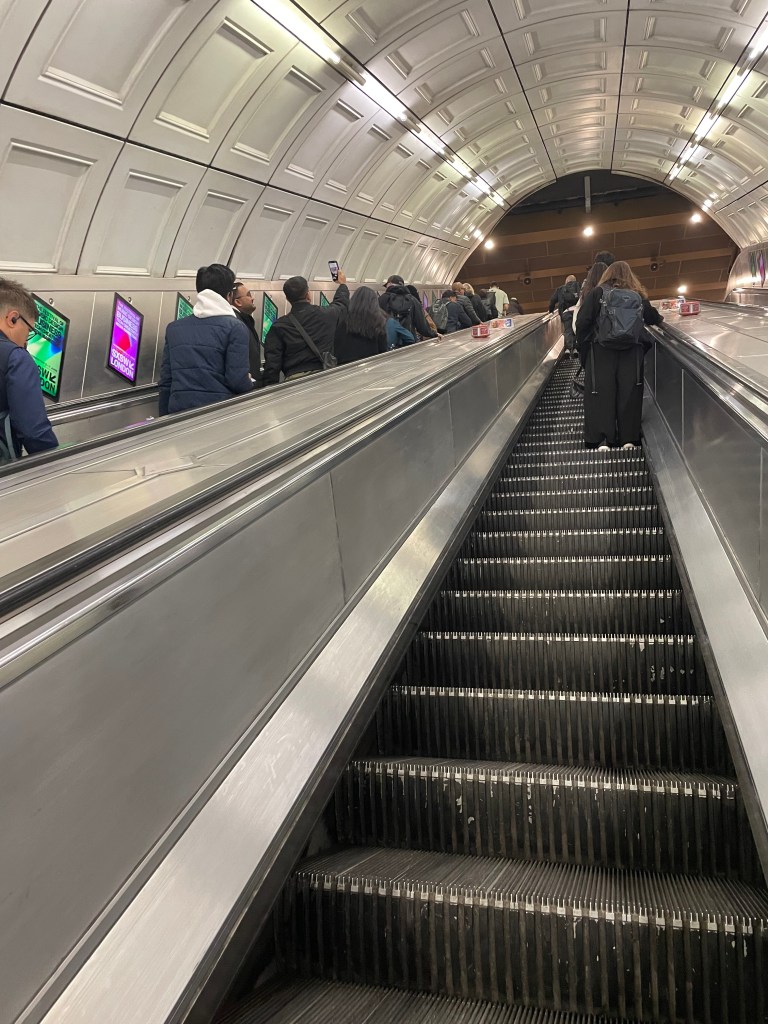
During my recent stay, in real life, I needed to visit colleagues based in Nottingham. So, I found my nearly self and my real self on a train heading north. In real life, I don’t think I’ve been to Nottingham for over 30 years, so nothing felt familiar, there was no skin to slip into, until I met my colleagues. But I decided in my nearly life, this was a trip I would take often. I filled my keep-cup with coffee, put on my brightest lipstick, and worked on my laptop on the train. For a few hours, I felt like a nearly adult. And it seemed that my nearly self knew exactly how to navigate the trains and underground systems so that I stepped seamlessly from one train to another, making it back to my son’s house almost before the 3 year-old’s bed time.
In real life, I worked in Nottingham before leaving for Canada. Another nearly. I could have stayed and carried on working in the same role at the same journal for 30 years. As I chatted over lunch with my colleagues, I realised that nothing much had changed. Sure, the journal is now digital. The copy is no longer typeset in-house. It is no longer printed on glossy reels, which I used to hang on the walls in the office so my brain could catch the typos as I walked by (indeed, there is no longer any office). The pages of the journal are no longer laid out by hand, although the heady mixture of caffeine, spray mount, and nicotine lingers in my memory as an accompaniment to the careful adjustment of text around tables and figures. Long ago, I updated the design and the colour of the journal. Bright green stripes with a photo on the front cover. I wanted researchers to walk into the library and spot the latest copy of the journal from the door. It has not changed since.
I followed the road less travelled, but it seems to have caught up to the other road, so that they almost converged and through the trees I caught a glimpse of my nearly world.
I’m writing this on my journey home to Wakefield. Back to my real life. When I left my nearly Nottingham life over 30 years ago, a friend, John Forth wrote a poem for me called Air Miles about how “…the next lot shrink the world to a day’s/ in-flght movie and think nothing of it…” . And it’s so true. I flip from one reality to the next with merely a short intermission.
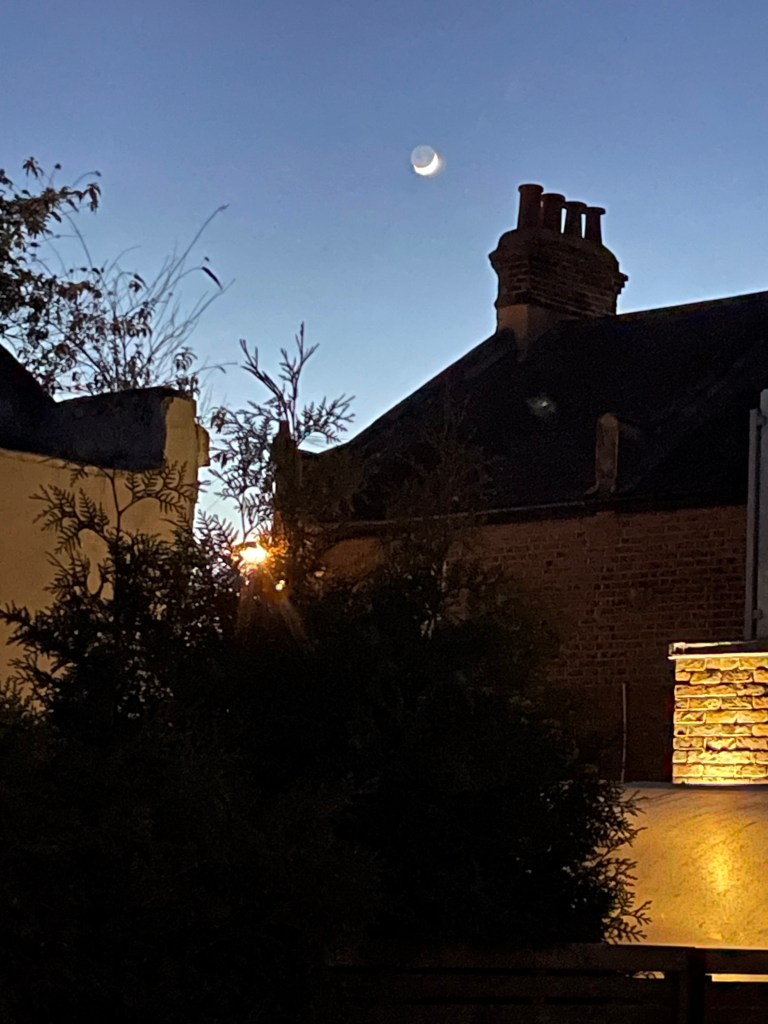

The night before I left, though, I looked at the moon hanging over the street where I live in my nearly life. Although obvious, I was struck by a sudden revelation. It is the same moon that hangs over the river in Wakefield. My real life and my nearly life are truly not so far apart.
Two roads diverged in a yellow wood,
And sorry I could not travel both
And be one traveler, long I stood
And looked down one as far as I could
To where it bent in the undergrowth;

Then took the other, as just as fair,
And having perhaps the better claim,
Because it was grassy and wanted wear
Wandering Wakefield would love to hear your “nearly” stories. So, if you feel like writing one for the blog, please get in touch.
Gillie Griffin

 Wandering Wakefield