The 1980s were a turbulent decade for Poles living under the yoke of General Wojciech Jaruzelski and the communist Polish People’s Republic (PRL). By 1987, the regime was struggling with a severe economic and debt crisis, the lingering effects of martial law (1981-1983), widespread public opposition to proposed austerity measures, and the growing influence of Solidarność (Solidarity) – a massive independent trade union and social movement founded in 1980 and led by Lech Wałęsa.
Against this backdrop, a young Polish family decided to leave their homeland and begin a new life. The family, made up of artists Anna, Antoni and their young son Wojtek, made the decision to go to Germany where they lived as temporary residents in the town of Münster, the historic capital of Westphalia. In 1988 they applied to immigrate to Canada, a process that was to take two and a half years.
While in Germany, they received social assistance and qualified for a two-bedroom apartment which a social worker helped them find. They were provided with a small allowance of 4000 Deutsche Mark (DM) to furnish their apartment, and they were able to source everything they needed. They put the money into useful things like a washer and dryer and not luxuries like a TV, a common purchase for many in their position. The social worker was impressed with how exemplary they were.
Filling their days, Wojtek went to school and was quickly fluent in German, and Anna studied German as part of a German language program (like ESL in Canada.) A challenge was their inability to work or exhibit their art without the necessary work permit.
Their social worker, impressed by their frugality and work ethic, helped them secure a permit to allow them to exhibit and sell their art. It was not long before they did not need financial support.
Wonderfully, the owner of the apartment building where they lived also took a shine to them and not only recommended their artworks to a local gallery owner, but also generously gave their young son a bicycle to go to school. Wojtek loved riding his bicycle, Anna not so much. A bike accident led to another serendipitous connection, when she was attended to by Dr. Dömer, an avid art collector and promoter. He not only became a patron but helped generate a loyal clientele which helped to pay for their tickets to Canada and leave them with enough funds to live in Canada for a year and a half.
Life in Germany was good, they were able to exhibit their art works, they had a nice apartment. Anna was able to enjoy her courses and Antoni enjoyed fishing in a local river.
One day in 1988 when visiting local friends, Antoni was in the backyard digging for worms and he uncovered a mouse nest. There were two tiny babies in the nest. Anna took the babies home and fed them with a syringe. Sadly, one of them fell into the cup of milk from which she was feeding them and died. The other, Mysia (mouse in Polish) flourished and became Anna’s constant companion.
From the beginning Mysia’s favourite spot was to curl up and sleep in Anna’s sleeve. Mysia went everywhere with Anna. Whenever they came across plants, Anna fed Mysia their seeds. Mysia enjoyed a very varied diet.
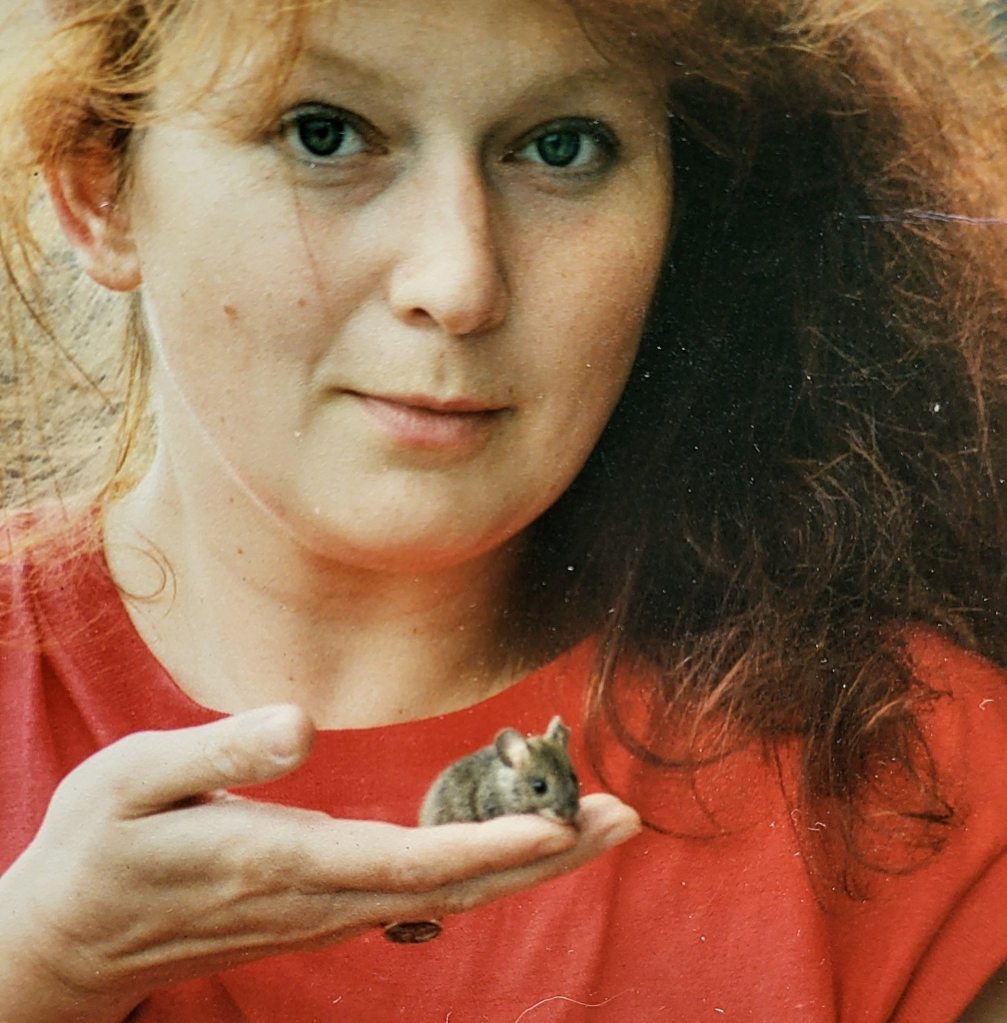
Anna also adopted a cat, Balbina, who turned out to be a bit of a nasty creature and did not like Mysia. Mysia stood her ground and bit Balbina on the nose and from then on Balbina kept her distance! And while Mysia also had a cage for refuge, she preferred Anna’s sleeve.
Life continued pleasantly and at the end of February 1990, the family got approval to immigrate to Canada. It was without hesitation that Anna decided Mysia was coming, too.
Luckily, in the days before the so-called “war on terror” and strict airport security checks, Anna and family breezed through customs. Mysia, secure in Anna’s sleeve, did not budge for the entire flight across the Atlantic! Not a peep.
The family was met in Toronto by Polish friends who had immigrated from Germany a few years before. On the recommendation of their friends, Anna, Antoni, Wojtek (and Mysia) carried on to Ottawa, and the potential of many galleries to show their work. Disappointed by the lack of galleries in Ottawa, they contemplated a move to the more cultural cosmopolitan city of Montreal, but by the time the container came with their personal effects, they decided to stay.
They had rented an apartment in Manor Park with a view of the Beechwood Cemetery. Anna and Mysia would often walk through the beautiful cemetery grounds and surroundings, where Mysia had ample opportunities to sample the new flora and nibble on seeds.
Anna enrolled in 6 months of ESL courses and continued to paint. As she painted, she listened to audio books. Anne of Green Gables was to become a favourite. Anna quickly learned English and was adapting well to life in her new country.
A carryover from her days in Germany, Mysia loved marzipan and, to be fair, so did Anna. One day, while researching galleries, Anna discovered Stubbe, a family run pastry shop at the corner of Dalhousie and Rideau. A six-generation family business with its origins in Germany, Stubbe sold the much-longed-for marzipan. As Mysia was an exceptionally well-behaved little mouse, who never caused a moment of trouble, Anna was thrilled to be able to share the much-loved treat with her wee mouse.
The new Canadians were soon to add to their family when a stray cat came to the door one day with very damaged paws. It appeared she had come a long distance, and it appeared she was pregnant! Kicia, as she came to be called, knew she had found a good caregiver and that she could rest easy. Kicia wailed on the day she gave birth, entreating Anna to stay home from school to be with her in her travail. Five kittens were born. Four found new homes and one calico cat, Laciatka, stayed. Both Kicia and Laciatka never saw Mysia as a toy or a treat. They understood she was family and while not enamored, respectfully kept their distance.
Mysia remained Anna’s constant companion. When out and about, no one knew that Mysia was in Anna’s sleeve. She never peeped and never gave anyone a scare.
After 3 years, 2 months and 28 days of joyful living, Mysia died while lovingly being stroked by Anna. In the wild, she would be lucky to live two and a half years. In mice years she was Methuselah!
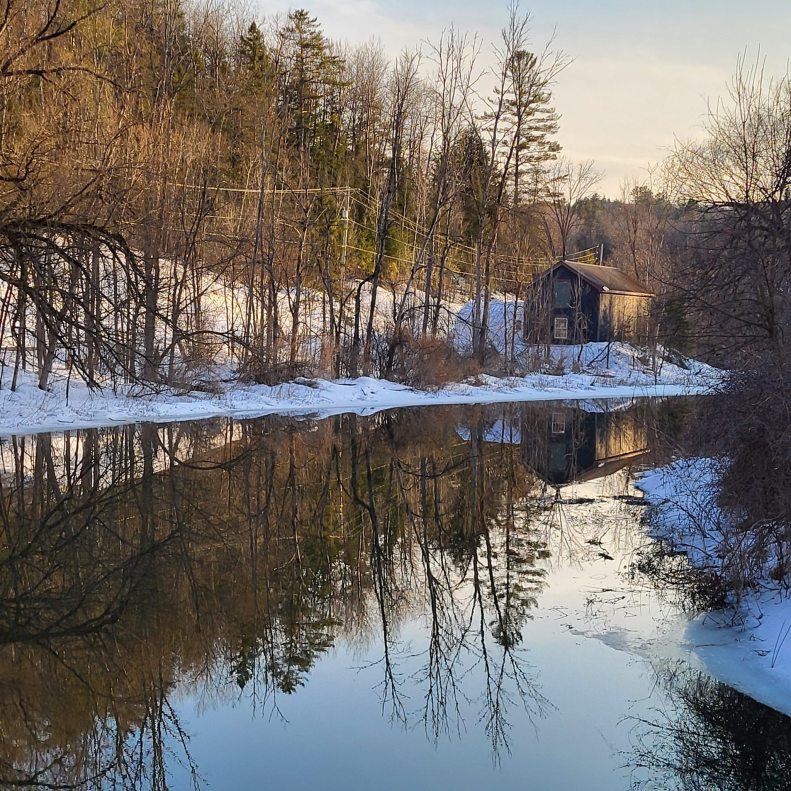
It was decided that Mysia needed a special final resting place. Frequent visits to the village of Wakefield had convinced Anna that Mysia should rest on the banks of the La Pêche River off Mill Road. And so, Mysia, the illegal immigrant, was returned to the earth.
Anna went on to have many pets – rats and cats. None were as unproblematic as Mysia.
Anna, Antoni and Wojtek moved to a co-op on Henderson Ave, where Anna was to spend the next 34 years. While living in the co-op they met two Danish artists; Greta, a painter, and Peter, a potter. Greta was to be my link to Anna.
I had come to know Greta when as co-founder of Canada’s Women’s Environmental Network (WEN), I organized an art exhibition to benefit WEN and showcase the artwork of the various international women artists who participated.
When engaged in a bigger project with the National Capital Commission to paint the hoarding around the old Daly Building site with artist’s representations of Canada’s provinces and territories, Greta introduced me to Anna, and Anna actually took on two provinces – Saskatchewan and Quebec, both of which received the highest praise in the review in the Ottawa Citizen’s arts section.
Anna and I became fast friends. When I moved with my family to rural Quebec in 2001, Anna and Antoni were always happy to visit and often looked after our various dogs and cats when we were away on travels or visiting family. After Antoni’s unexpected death in 2010, Anna continued to pet sit, and our pets were always delighted with her presence. It was a win-win-win.
It was only in a recent telling of Mysia’s story that I learned the details of Anna’s immigration to Canada and earlier connection to Wakefield.
Whether dogs, cats, mice or people, I have found there to be glorious, serendipitous connections that forge friendships and impact the course of our lives. Perhaps, there is no better way to end this story than by borrowing from Anne Shirley, one of Anna’s heroines, “Kindred spirits are not so scarce as I used to think. It’s splendid to find out there are so many of them in the world”.

 Wandering Wakefield