by Pearl Pirie
People I talk with have been around Wakefield for generations, or decades, and I’m just coming up on a decade of stomping these hills, although technically my ancestors came through going towards Shawville in the 1820s-1880s. It’s always a bit tricky talking about where I live as only those who were regulars at the Blacksheep seem to know where Wakefield is. Anything smaller than the town and people are at sea. I list towns and people shake their head. Maniwaki sometimes registers. Gatineau sometimes depending on how far the person is. Is community geography? Or interaction? Or a choice of belonging.
One can get up in your own head about belonging. People are transient seeds, windblown dandelions even if slower to fly and slower to put down roots. People that meet daily can be contextual acquaintances despite all the conversations had. You move away and they and you fall off to separate earths. (Or don’t.) Change is the way of things, but it doesn’t prevent it from being dismaying. On isolated days I feel hesitant to claim any community and want to start a petition to see if I have numbers for who claims me.
too busy to think—

aquatic snails scribble

the lake bottom
There are many ways to have community, to participate in many circles. Some of us volunteer at the library, or at Rupert Treasures. Some at the hospital boutique, or with the choir, or Girl Guides, the Writers Festival, school fundraisers, or the food bank. Some build community by going to card days, or games nights, to Share the Mic, or musical events. Showing up can be less formal— holding open a door, chatting with strangers, or pulling over to see if you can help someone change a car tire. A wave or a call of good morning, or holding a gaze is all to say, I see you. You are safe here.
park bench kiss–

at first we don't see

they're seniors
People you meet yearly or every 2 or 3 years, as with a haiku group, feel connected. It’s a slow-motion relationship but founded on commonality. Of all the people that exist, these are you people, also interested in books, reading, writing, nature, and of those, in poetry. Of that subset, interested in short forms, within that, in haiku, within that, a particular subset of English Canadian haiku that is playful and flexible. And of those, not too shy to talk with people and share their poems.
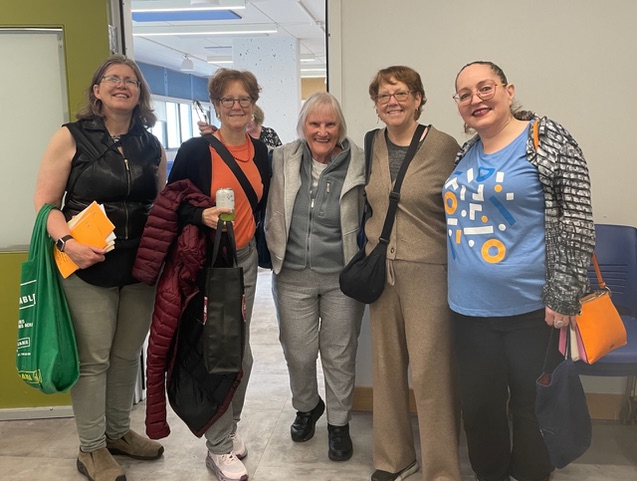
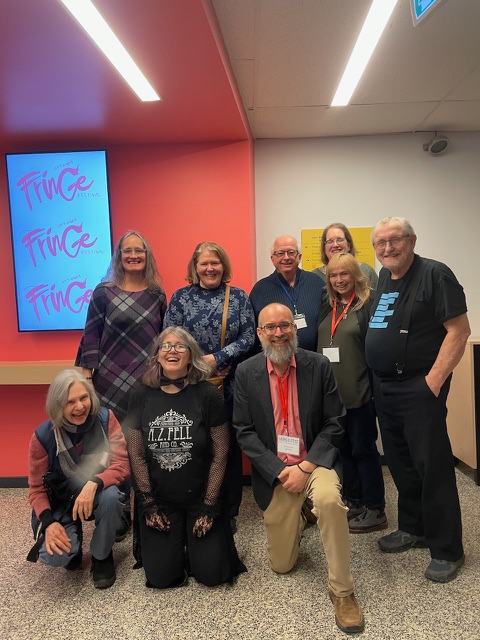
What is community? It’s a choice to come together. It’s a group gathered for photos with people chanting my name to join them– that happened at the Haiku Canada Weekend in Kingston last week. It touched something in me. Unambiguous welcome as being a part of an us. Something one step more than people lighting up and running over with hugs. A reunion with the haiku family. It does the heart good.
her rare tight hug—

orb weaver’s egg sac

carried high
I’ve been doing haiku for about 35 years and have given workshops on them to various groups. (Perhaps we can stir up interest to do another one at Write Night this fall.)
What I’ll say next isn’t a pitch, so much as a sharing excitement: Next year is Haiku Canada‘s 50th anniversary. I’ve been a member of the organization for over 20 years. I am also the new English reviews editor at the print and online place for Haiku Canada, Haiku Canada Review, and the online Shohyōran (HCshohyôran) and I tweet for the group, and coordinate one of our contests. You could say I’m more than hip-deep.
Haiku Canada tries to move the annual gathering East, West, North, Central each year so it gives everyone a regular chance to have it relatively closer and cheaper to get to. The next weekend-long conference will be the May long weekend 2027 in Saskatoon at the University of Saskatchewan, Department of Education. There’s also a smaller getaway in September in New Brunswick.
Between conferences, there’s the email news. And local groups that meet every couple of weeks to quarterly. Some groups make haiku paths with placards of haiku in parks, or combine events with ikebana displays, or pottery groups. Some do newsletters, library installations, local anthologies. Because it is a big anniversary year for the national group, each month more activities are being planned across Canada to introduce people to haiku and related forms.
The haiku writing group I’m in locally, KaDo, gathers people from Gatineau to Kingston to Carleton Place for Zoom and in-person walks or talks. KaDo also presents someone at VERSeFest Ottawa each spring.
There’s a certain amount of variance in what people think a haiku is. Some teachers leverage it as a way to explain syllables in a sentence. 5 syllables, 7 syllables, 5 syllables, line breaks anywhere. For example, “When Trump dies I’ll cry/tears of joy and relief that/we can start again”, which is not a haiku.
Some practice haiku as short, long, short lines, with a guideline of one breath long. Some are even a word long. The outer shape isn’t the key element so much as the spirit, a demonstrated feeling shown through things, a pivot as in a sonnet, the attention to surface and deeper elements at the same time, and the sense of aha. Bonus points some ambiguity from multiple reads of meanings.
Here are some more haikus I have had published in anthologies and chapbooks,
Habitant soup —

tinned taste just like mom

used to heat

*

trainquility

*

New Year’s Eve—

the spectacular show

of his tight jeans

*

satisfied silence—

spring peepers

*

      a leaf falls

               missing your hair

my hand
Haiku ends up being a good accompaniment for taking stock, being present, slowing down, observing where you are. And, when you’re ready, sharing them in the community that you make by sharing yourself and letting others share themselves in a spirit of openness. That seems to me like a very good fit for the Wakefield culture. How do you haiku?
Pearl Pirie is a poet with 4 collections, most recently Footlights (Radiant Press, 2020). She won the Nelson Ball prize for poetry of observation for the chapbook rain’s small gesture (Apt 9 Press, 2021)

 Wandering Wakefield