By Kaya Hipwell
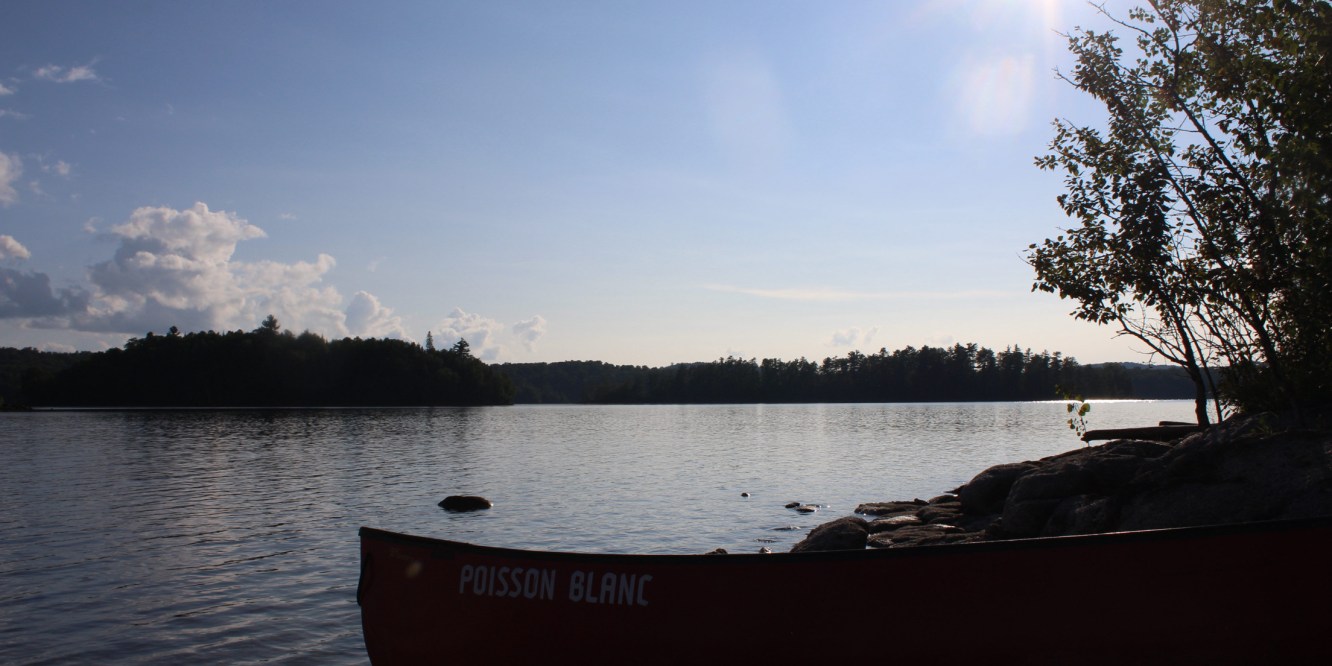
On Friday, August 21st, I returned home from 5 days of paddling and camping on the Poisson Blanc reservoir in the Laurentides region of Quebec, on a program called Riparia. Riparia is a Canadian organization that aims to connect young women with water science. With me was a group of 16 other women; 10 other teen participants, 6 adults with vast amounts of ecological, scientific, and outdoor knowledge. It was the trip of a lifetime. I learned so much about myself, the earth, and how water is connected so deeply to our day-to-day life.
I was picked up at the Cantley pickup location at 9:30am on Monday the 17th by a bus. It was packed with my peers going on the trip, every seat was filled. There was an awkward silence that filled the space in the bus between participants who didn’t know each other, but I had a feeling this silence would be short lived.
We arrived at the Poisson Blanc regional park administrative offices around an hour after we left Cantley. On the bus ride our driver entertained the quiet crew by getting us to play a game where we collectively tried to think of at least one animal for each letter of the alphabet. Many people seemed hesitant to break the silence with their answers, but I quickly learned through them how intelligent the group was as they named species I had never heard of
Upon arrival we were greeted by the friendly faces of our chaperones and teachers for the week. Dalal, who is a professor of conservation science at Carleton University and co-founder of Riparia. Gretchen, who was support staff for the University of British Colombia’s Centre for Indigenous Fisheries and worked as a program leader. Zofia, another program leader on the trip. Chantal, a Department of Fisheries and Oceans Fisheries Officer. Serena, an undergraduate honors thesis student in Biology at Carleton University who served as an apprentice science guide on the program. And Oona, an undergraduate student who served as an apprentice guide as well.
We were quickly given gift bags full of thoughtful items, a pair of leggings, a Riparia hat and shirt, stickers, home-harvested honey, organic mint tea, an insect colouring book, a headlamp, a waterproof notebook and a post card with a cover that states “We are here to protect our water,” a statement I didn’t realize at the time would come to resonate so much with me by the end of the trip. The organizers went above and beyond for us throughout the trip, they truly thought of everything.
The next few days were a mix of things: meals together as a group, learning how to stern a canoe, swimming in the very welcoming lake with personal flotation devices for safety, moments for self reflection, packing gear and loading canoes, paddling to new sites, down time to recuperate, games to bond as a group and learn names, and so much more. Every day included scientific activities such as a fish dissection, water testing, and a look into insect life in streams. A sense of peace came over me for the duration of the trip. All my worries seemed to wash away, and things like checking the time became unimportant.
By day two the group was already getting closer. Laughter filled any possible silence, inside jokes were made. Faith and Gracie, two participants, named their fish Alex during the walleye dissection, our first scientific activity, which turned into Alex being brought up every day that followed.
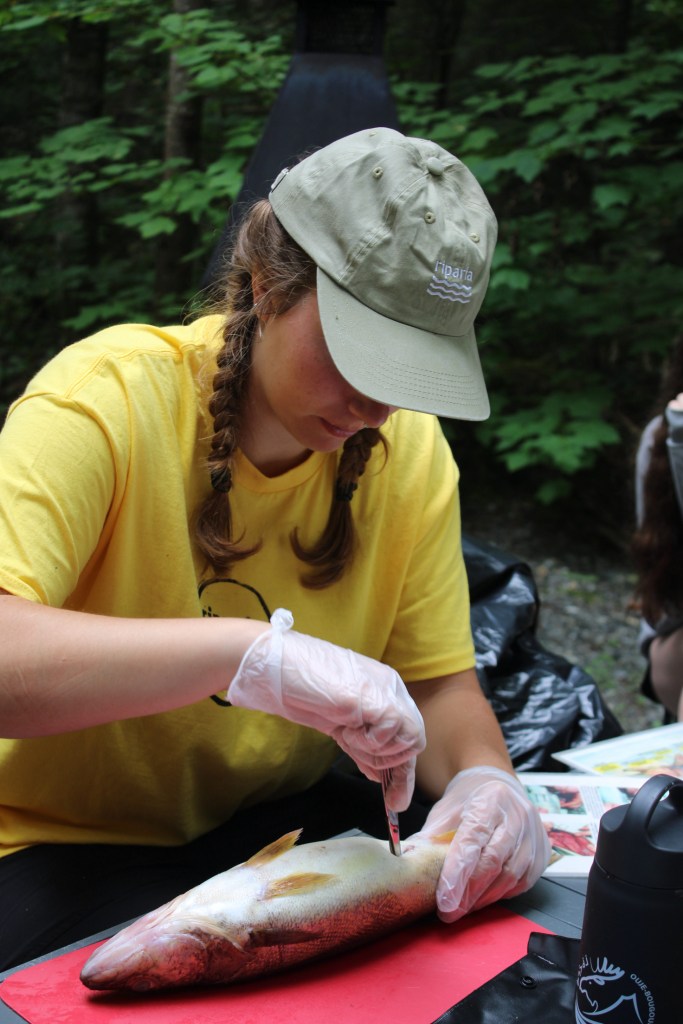
Everyone seemed so interested in learning. My partner for the dissection, Emma, seemed less than thrilled by the ideal of cutting into a fish, but still she stuck around and watched as I shifted through the guts trying to locate things like the pancreas and gonads, most likely while holding her breath. Despite her dislike of the fish dissection, she did not sit out and opted instead to simply watch and learn.
I wanted so badly to learn everyone’s names, that every day when the group gathered I looked at every person’s face and tried to say their name in my head. Dallal, Zofia, Gretchen, Oona, Serena, Chantal, Emma, Faith, Gracie, Ada, Kahnawiiostha, Pippa, Sarah, Ark, Zoe, Mercedes, I would say silently in my head every time we sat down for meals, or to sit around a lit fire. Even though we only spent five days together, I never want to forget any of the amazing women I was with.
When I had to pack up for our paddle to our second site, I realized it was the only non enjoyable part of the trip. I squished and squeezed with all my might to get everything I brought into my bag. That and the mosquitoes were the only part of the trip I did not enjoy. Everything else was pure bliss, a dream come true.
Every night, we would share with the group our apple, onion, and cherry pie. Apple being our favorite part of the day. Onion being our least favorite aspect of the day. And cherry pie was an opportunity to shout out someone we thought did something amazing that day. I always had to pick one of many apples, and try to think of something I could possibly consider a onion. Packing up was my onion three out of the five days
When we arrived at the next site on day two, we were told that there would be five daily chores, done in pairs. There was a pair of fire keepers, water fairies, tarp techs, cooks, and dish washers.
I was paired with Kahnawiiostha and assigned to be a water fairy for our second day. Oona showed her and I how to use a gravity based water filtration system, filling the unfiltered side with lake water, and attaching a cylindrical filter to a small tube coming out of the bag, which in turn ran down to the filtered water side, attached by another tube. I was told the alternative to a filtration system would be to put chlorine tablets into our drinking water, which I found a little shocking and couldn’t imagine would taste good.
On day three our scientific activity was learning how to use a water testing kit, to determine the quality of the water body. I learned a lot that day about testing water. Testing the conductivity, the pH level, the level of diluted oxygen, etc. The activity made me consider the idea of doing civilian water testing for the Gatineau river, something I may pursue as a hobby.
We also learned about watersheds. Every piece of land in the world is part of a watershed that feeds into streams, rivers, lakes, and oceans. It makes water bodies very fragile and susceptible to even minor changes in the land up-stream to them. For example, people over salting their driveways during Winter leads to spikes in the salinity of water bodies come Spring. Hearing this made me feel a responsibility to the lakes and rivers around me. If we don’t protect them as a whole, they will suffer from our lack of care.
By the last day the group dynamic had completely shifted. There was an excitement to return to family, but even more so a sadness to leave the one we made at Lac du Poisson Blanc. Everyone had become so close that it was almost like being with a different group than the one I sat with on the bus ride in.
On the return trip home the van was a bustling energy. There was not a moment of silence, not a moment without joy and laughter. We exchanged each other’s contact information, and even asked and answered deeply personal questions.
I think this experience changed every one of us in some way, but I can only speak about how it changed me. An aspect of the Riparia’s program is that participants are asked to leave electronic devices at home. It was a full five days of no phone, no checking texts or answering snap chat notifications, and it was amazing.
The only part that I didn’t like about that was that I couldn’t contact my mom Kim, and my dad Bill, my brother Leon, my best friend Aisling, and other friends and family, who I missed very much and was dying to tell all about the amazing time I was having. But being without my phone often felt more like a blessing then a burden. It amazed me how much more I did with the days, not only because of the fact that I was on a scheduled program, but even just with free time.
I read over 100 pages of my book while away, more than I had read collectively in the month before the program. That alone took less time then the average I would spend scrolling social media during a day at home.
It made me rethink my use of my phone, and how it could be controlling my time. At home I was completely captured by my phone in certain moments, but on the program I had no problem going without it and reaping the benefits. Since returning home I have tried to transform my phone usage, I have attempted to begin using it simply as a tool when information is needed, and a means of communication with those close to me. I am trying to cut out my doom scrolling habit altogether and repurpose the time for more important endeavors. It is difficult but the trip showed me that it is possible.
Sometimes I still catch myself swiping away on TikTok, but the trip gave me the ability to pull myself out of those moments if the time can be better spent differently. This is one of impacts that Riparia as had on me, that I perceive to be long lasting and immensely positive.
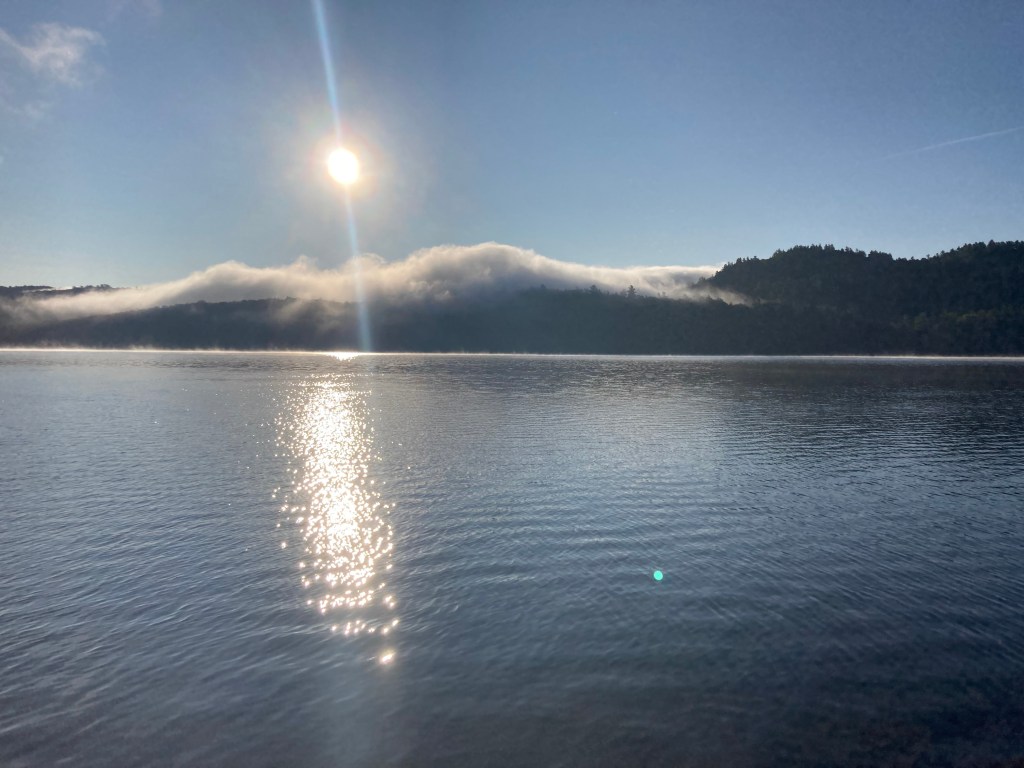
Another thing about the no phones policy that I was worried about, was the inability to take photos. But of course, the Riparia crew thought of that too. With us were two cameras, an Instax Polaroid camera, which we could take two photos with, and a Canon camera which we could take all the photos we wanted with. On the second last night I took a photo of the lake and I felt a draw to photography I never had before. The shot was so pristine, the lake stretched endlessly in the background and sun rays shone in the perfect places. It was nothing like a shot with a cell phone camera, it had a certain detail that a phone couldn’t capture. I am now heart-set on saving up for a Canon camera of my own. Riparia didn’t just give us an experience, it ignited passion within us.
In terms of future plans, Riparia made me realize that my future job needs to involve being outdoors. I’ve never felt as at peace as I did out in a canoe on the water. I’m not sure exactly what job I will end up having, but ideally I would love to be surrounded by the beauty that enveloped me on the trip.
Riparia really got me thinking about future plans, and what kind of life I want to live. I feel it gave me some direction as to where I want to go in life. This came at the perfect moment, as Cegep was around the corner, and Riparia gave me a passion for my future.
Now that I have returned home, I feel a connection to my self that is different than before. I feel the self reflection activities we did, and the environment we were in largely contributed to that. For example, on day three we stopped at a small beach along our paddle to our next and final site. Zofia introduced a new activity of sorts, for serenity, and self reflection, called a ‘Sit Spot’. This involves finding a place where you can sit and have no other person within your field of vision. It works best if you are somewhere outside in nature and if no one around you is speaking loudly. You simply find this space and sit down, getting comfortable, and stay for 10 minutes. You’re supposed to focus on your five senses, and avoid thinking about plans and responsibilities.
I sat down on a rock along the shore, and let my gaze reach across the water as the sounds of slow, gentle waves rolling in filled my thoughts. I pondered lightly about the lack of such activities in my day-to-day life, and although this is planning, I made a promise to myself to make time for them in the future. I found this activity immensely peaceful, and returned saying that I felt as though I had just returned from a spa of sorts.
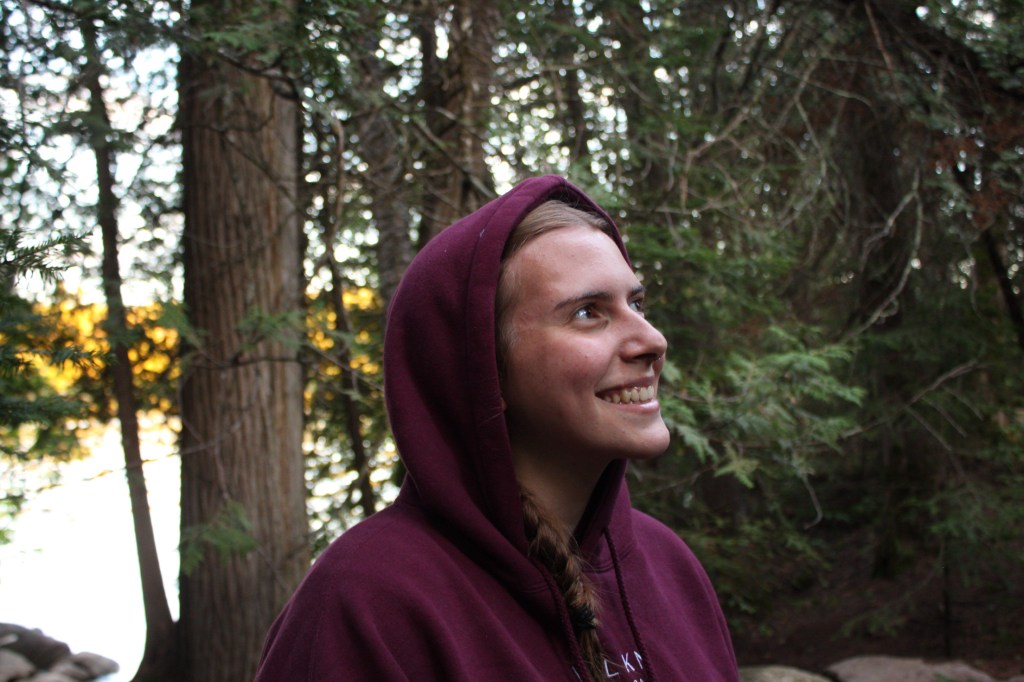
Riparia also really changed the way I viewed the environment. It gave me a sense of everything being connected, no action is without its consequence in nature, whether positive or negative. Cows upstream can lead to water being contaminated by E. coli in a lake kilometres away. Over-fishing one kind of fish leads to an imbalance within the entire ecosystem.
Often science is looked at in an arboreal way, like individual trees with one action leading to one consequence, which in turn leads to its own consequence. I believe in a more rhizomatic way of looking at things being linked like the interdependent root system of grass, that everything works together. Without fully understanding that, it is my view that there is no way to properly protect our planet while doing scientific research, testing, and innovation.
This program’s aim is less science and math focused. Its goal is not to have many participants go into STEM (although that is always positive), but more so to connect women to water and show it’s influence in our daily life. It hopes to give people the outdoor experience that it takes to love this earth and care for it.
Riparia’s funders are various, including National Geographic Society, NSERC, Patagonia, etc. This year’s program was given a generous donation from Evripos, as well as funded by the Blue Future Pathways Program which is run by the Students on Ice Foundation. It was founded in 2019 by Dalal Hanna, Andrea Reid, and Mikyala Wujec. It is currently directed by Dalal Hanna and Andrea Reid.
I am so grateful to have been selected for Riparia’s program this year, it has changed me as a person for the better.

 Wandering Wakefield